
Discoid Roaches
Why Discoid Roaches Are Legal in Florida: The Full Regulatory Story

The Short Answer
Discoid roaches (Blaberus discoidalis) are legal to buy, sell, breed, and possess in Florida, with no state permit required. That single sentence answers the search query that brings most people to this page, but it also raises the question that actually matters: legal compared to what, and legal because of what? Florida has some of the strictest live-arthropod regulations in the country, and the state's own Department of Agriculture has, within the last few years, moved a closely related feeder insect — the dubia roach — into a restricted category that most hobbyists can't practically comply with. If Florida is willing to do that to one feeder roach, understanding why it hasn't done the same to discoid roaches tells you something real about how the state actually evaluates risk, not just a marketing line repeated across every feeder-insect website.
More detail in our guide to which pets are illegal in Florida.
This piece goes deeper than the usual one-paragraph answer. It covers which state agency actually regulates live insects in Florida (it isn't the one most articles name), the specific rule and statute involved, why dubia roaches ended up restricted, the biological reasoning that keeps discoid roaches off that list, and what all of this means practically for keepers, breeders, and Florida pet stores.
Who Actually Regulates Live Insects in Florida
A lot of feeder-insect content online attributes Florida's roach rules to the Florida Fish and Wildlife Conservation Commission (FWC). That's an understandable mistake — FWC is the agency most people associate with Florida's exotic-animal reputation, thanks to its very public work on Burmese pythons, green iguanas, and other high-profile invasive vertebrates. But FWC's jurisdiction is built around wildlife: reptiles, mammals, birds, and other vertebrate species. Live insects and other arthropods fall under a different agency entirely — the Florida Department of Agriculture and Consumer Services (FDACS), specifically its Division of Plant Industry. FDACS publishes its own official arthropod and invertebrate permitting page, which is the authoritative source for current species classifications and permit requirements — not this article, and not any other feeder-insect blog.
That jurisdictional split makes sense once you think about why Florida cares about non-native arthropods in the first place. FWC's mandate is protecting native wildlife and ecosystems from vertebrate predators and competitors. FDACS's Division of Plant Industry exists to protect Florida's agriculture — its crops, its nurseries, its citrus and vegetable industries — from pests. Insects, mites, and other small invertebrates are exactly the kind of organism that threatens agriculture, not through predation but through crop damage, disease vectoring, and uncontrolled reproduction in growing regions. A roach species that could establish outdoors in Florida isn't primarily an FWC-style "eats native wildlife" problem — it's an FDACS-style "spreads through agricultural and residential areas and can't be un-released" problem.
The specific legal framework lives in Florida Statutes §581.083 and Rule Chapter 5B-57 of the Florida Administrative Code. Together, they give FDACS the authority to regulate the introduction, possession, and movement of non-native arthropods, plant pests, and biological control agents within the state. Species get sorted into categories based on assessed risk — some require no permit at all, some are "conditional" and require a permit plus specific containment standards, and some are prohibited outright. This is the actual legal machinery that determines whether you can order a box of feeder insects to your Florida address without breaking state law, and it's worth understanding in more detail than "the state banned it" or "the state allows it," because the reasoning behind each category is where the real answer to "why are discoid roaches legal" lives.
The Conditional Species System, Explained
Florida doesn't run its non-native arthropod rules as a simple legal/illegal binary. There are, broadly, three practical outcomes for any given species under Chapter 5B-57:
- No permit required — the species has been assessed and doesn't present a meaningful risk of establishing outdoors, damaging agriculture, or disrupting native ecosystems. It can be sold, bred, shipped within the state, and possessed without any state-level paperwork.
- Conditional species — the species presents enough theoretical risk that FDACS requires a permit to possess or sell it, along with specific containment requirements (secure housing, escape-proofing standards, sometimes facility inspection) designed to prevent captive populations from becoming wild ones.
- Prohibited species — the risk is considered high enough that the state doesn't allow possession at all, permit or not, outside of narrow research/institutional exceptions.
This is why you'll sometimes see conflicting-sounding claims online — one site says dubia roaches are "banned in Florida" and another says they're "legal with a permit." Both are functionally describing the same conditional-species status. For a large-scale commercial breeder willing to go through permitting and build compliant containment, a conditional species can, in principle, be kept legally. For the overwhelming majority of home reptile keepers and small breeders — the audience actually buying feeder roaches by the deli cup or the bulk bag — a permit requirement is a practical wall. Nobody is filing state paperwork and building an inspected containment facility to keep a feeder colony for their own bearded dragon. So while "banned" isn't the precise legal term, it's an accurate description of the real-world effect for almost everyone who searches for it.
This three-tier structure isn't unique to roaches. Florida applies the same framework to a huge range of non-native plants, insects, and other organisms — it's the same general system that governs everything from certain ant species to specific beetle species used in biological pest control. Understanding that discoid roaches sit in the "no permit required" tier, while dubia roaches sit in the "conditional" tier, is the entire answer to the legality question. The interesting part — and the part most articles skip — is why the state's risk assessment landed differently for two roach species that look and behave almost identically to a reptile keeper.
How the Permitting Process Actually Works for a Conditional Species
It's worth understanding what a conditional-species permit actually requires, because "you can get a permit" undersells how much of a barrier that process is for a typical hobbyist. FDACS conditional-species permitting generally involves submitting a formal application identifying the species, the intended use (research, commercial breeding, retail sale, and so on), and a description of the containment facility the applicant will use. That facility description isn't a formality — FDACS can require specific physical containment standards designed around the biology of the species in question: secure enclosures rated to prevent escape given the species' known climbing or flight ability, sometimes double-containment (an outer barrier in addition to the primary enclosure), and in some cases a facility inspection before or after the permit is issued to confirm the containment actually meets the standard on paper.
There are also ongoing compliance obligations once a permit is issued — recordkeeping requirements, sometimes periodic reporting, and the standing risk that a facility found out of compliance can have its permit revoked along with other consequences. None of this is unreasonable from a regulatory standpoint; it's the same basic model used for any conditional or higher-risk species across many states, not something unique to Florida or unusually punitive. But it's a genuinely different proposition than what most reptile keepers picture when they hear "you can keep it with a permit." It's closer to a small-scale facility inspection and compliance process than a form you fill out once and forget. For a commercial operation already built around regulatory compliance in other areas — a licensed breeder, an established pet store with existing state relationships — it's a manageable cost of doing business. For someone who wants to keep a feeder colony for their own three bearded dragons, it isn't realistic, and that's the practical distinction that makes a "conditional" species function, in effect, like a restriction for most of the market.
A Brief History of Why Florida Takes This So Seriously
Florida's regulatory caution around non-native species didn't develop in a vacuum, and understanding the state's actual track record makes the roach-specific rules easier to place in context. The Everglades' Burmese python population is the most famous case: originally established from escaped and released pets beginning in the late 20th century, the population is now large enough that state and federal agencies run organized removal programs, python-hunting contests with cash prizes, and ongoing research efforts — and even with all of that investment, eradication is considered functionally impossible at this point. The pythons have measurably reduced populations of native mammals across large parts of the Everglades ecosystem, a documented ecological cost that took years of unchecked breeding to reach and that no amount of retroactive regulation can undo.
Cuban tree frogs are a smaller-scale but similarly instructive case — introduced accidentally through cargo shipments decades ago, they've since spread across most of the state and are documented predators of native tree frog species, contributing to declines in some native populations in areas where the two overlap. The giant African land snail is the clearest agricultural analogue to the roach situation: a species FDACS has fought through multiple detection-and-eradication campaigns because of its capacity to damage hundreds of plant species and even structures (the snail's shell composition means large populations can affect stucco and other building materials), at a public cost running into tens of millions of dollars across various eradication efforts over the decades.
Every one of these cases shares the same underlying lesson that now shapes how FDACS evaluates any new non-native arthropod, roach species included: prevention is inexpensive and highly effective, while remediation after establishment is expensive, often incomplete, and sometimes simply not achievable at any cost. That history is the real backdrop against which "why does Florida restrict some roach species but not others" makes sense — it's not an arbitrary bureaucratic distinction, it's a state applying hard-won lessons from previous introductions to a new evaluation, species by species, before those species have the chance to become the next expensive case study.
Why Dubia Roaches Became a Conditional Species
Dubia roaches (Blaptica dubia) are native to a broad swath of South America — Brazil, Argentina, Paraguay, and neighboring regions with tropical and subtropical climates. That's precisely the problem from a Florida regulatory standpoint. Florida's climate, especially in the central and southern parts of the state, is warm and humid enough for much of the year to closely resemble the native range dubia roaches evolved in. A roach species that already thrives across a range of South American climates zones very similar to peninsular Florida is, on paper, a plausible candidate to survive and reproduce outdoors if enough individuals escaped or were released.
Florida's caution here isn't theoretical or reflexive — it's informed by decades of expensive, ecologically damaging experience. Burmese pythons in the Everglades, Cuban tree frogs displacing native frog species, cane toads, lionfish in coastal waters, and the giant African land snail (a genuine agricultural pest FDACS has spent years and significant budget trying to eradicate) are all cautionary tales that shaped how seriously the state now treats any non-native species with a plausible path to establishment. Once a population is loose and breeding in the wild, there is often no realistic way to remove it. That asymmetry — cheap and easy to prevent an introduction, enormously expensive and often impossible to reverse one — is why Florida's regulatory posture leans precautionary rather than permissive when there's real uncertainty.
For dubia roaches specifically, the risk factors that mattered were their broad climate tolerance matching Florida's own conditions, their prolific breeding rate (a single female can produce dozens of offspring in a reproductive cycle, and colonies scale quickly), and the sheer volume of dubia roaches moving through the pet and reptile-feeder trade nationally, which multiplies the number of potential escape or release events. None of that means dubia roaches are established in the Florida wild today — as far as available records show, they are not — but "not yet established" and "assessed as low risk of establishing" are different things, and FDACS's classification reflects the latter judgment, not the former fact.
Why Discoid Roaches Were Not Restricted
Discoid roaches sit in a genuinely different position, and the reasoning isn't a technicality — it's a combination of range, biology, and existing ecological history that adds up to a much lower assessed risk.
Native and naturalized range. Blaberus discoidalis is native across a wide swath of the Caribbean and northern South America — Jamaica, Cuba, Hispaniola, Puerto Rico, Panama, Colombia, Venezuela, and Trinidad and Tobago all fall within its documented native or long-established range. Critically, the species also has a long-standing naturalized presence in parts of Florida itself. This isn't a species Florida would be evaluating as a brand-new potential introduction — it's one that has already been present in the state's ecosystem, in some areas, for decades, without triggering the kind of ecological disruption or agricultural damage that drives a species onto the conditional or prohibited list. When a regulator is assessing "what happens if this species establishes outdoors," a species that has already been quietly present for a long time with no documented harm is a fundamentally different case than a species with no Florida track record at all.
Poor dispersal biology. Discoid roaches cannot fly. Adults have wings, but they're vestigial for flight purposes — you will not see a discoid roach take off across a room the way some other roach species can. They also cannot climb smooth vertical surfaces; there's no adhesive structure on their legs comparable to what lets some other roach species scale glass or polished plastic. Practically, this means an escaped discoid roach is a slow-moving, ground-bound animal with no meaningful ability to spread quickly or colonize new areas on its own. Compare that to a species capable of flight or wall-climbing, and the difference in realistic spread potential — and therefore ecological risk — is significant.
Cold sensitivity limiting range. Discoid roaches are a warm-climate species with limited cold tolerance. Even within Florida, a hard freeze in the northern part of the state is enough to kill an unprotected outdoor population, which naturally caps how far north any escaped or naturalized population could realistically persist and spread. This isn't a species with the climate flexibility to become a statewide or regional problem — its viable range is bounded by the same subtropical conditions that already exist where it's historically been found.
No agricultural pest history. FDACS's core mission is protecting Florida agriculture, and the species that draw the strictest scrutiny are the ones with a documented history of crop damage, disease transmission, or aggressive competition with beneficial insects. Discoid roaches are detritivores and scavengers — they eat decaying plant matter, not living crops — and there is no record of them behaving as an agricultural pest anywhere in their native or naturalized range. That absence of pest history is a meaningful data point in any risk assessment, because it means decades of real-world observation across multiple countries and climates haven't produced the kind of damage pattern that would justify restriction.
Put together, that's a materially different risk profile than a species like dubia: overlapping climate tolerance without the poor-dispersal traits, without the existing naturalized presence, and — most importantly for a regulator — without decades of "we've already watched this species coexist here without incident" history to draw on.
The Caribbean and South Florida Connection, in More Detail
It's worth spending a little more time on the naturalized-population point, because it's the single biggest factor separating discoid roaches from a fresh introduction risk. South Florida's climate is subtropical, closely tracking the climate of the Caribbean islands and parts of Central America that make up much of Blaberus discoidalis's native range. Historical trade, shipping, and agricultural movement between Florida and the Caribbean over the past century created plenty of opportunities for a hardy, ground-dwelling roach species to make the crossing — in cargo, in agricultural shipments, in the ordinary churn of a region with constant maritime and now air traffic to and from the islands where it's native.
The result is a species that, by the time FDACS's modern arthropod-permitting framework was built, was already a known, long-present part of South Florida's insect fauna rather than a novel candidate for introduction. Regulatory risk assessments generally treat "species already here, doing what it's been doing for decades, with no documented harm" very differently from "species with no Florida history at all, imported at commercial volume through the pet trade, with a climate-matched native range." Discoid roaches fit the first description. Dubia roaches, despite superficial similarity as feeder insects, fit the second.
This is also why comparing discoid roaches to dubia on the basis of "they're basically the same insect" — which is true nutritionally and behaviorally — misses the actual regulatory question. Florida's rules aren't sorting roaches by how useful they are as reptile food. They're sorting them by an entirely separate axis: what happens to Florida's ecosystem and agriculture if this specific species ends up loose outdoors at scale. On that axis, a species with an established, harmless Florida history and poor dispersal biology looks nothing like a species with no Florida history and a climate-matched, prolific-breeding native range — even if the two are nutritionally interchangeable in a feeding bin.
What "Legal" Actually Means, Day to Day
For a Florida reptile keeper, breeder, or pet store, discoid roaches' no-permit status translates into a genuinely simple set of facts:
- No state permit is required to purchase, possess, breed, or sell discoid roaches in Florida.
- There's no state-imposed quantity limit — a small home colony and a large-scale breeding operation are treated the same way from a possession standpoint.
- There's no special containment standard mandated by the state the way there is for a conditional species (ordinary responsible feeder-insect husbandry — a secure bin, since discoid roaches can't climb out of a smooth-walled container anyway — is what's needed, not a state-inspected enclosure).
- Interstate shipping into Florida doesn't require special import paperwork tied to the species' non-native status, because it isn't classified in a way that triggers that requirement.
That's a meaningfully different experience than trying to legally keep a conditional species as a hobbyist. It's also why discoid roaches became the default replacement feeder for the many Florida keepers who'd built their feeding routine around dubia roaches before the restriction took effect — the two species are close enough nutritionally and behaviorally that switching doesn't require rethinking a feeding program, just switching suppliers.
One caveat worth stating plainly: this article describes the regulatory landscape as it currently stands, based on Florida Statutes §581.083 and FDACS's arthropod permitting framework under Chapter 5B-57. State regulations are not static — species classifications get reviewed and can change as new risk information becomes available. This is general information, not legal advice, and anyone with a real compliance question — a commercial breeder scaling up, a pet store adding a new species to its lineup — should verify current status directly with FDACS's Division of Plant Industry rather than relying on any single article, including this one, as a final legal source.
How This Compares to Other Feeder Insect Species
Dubia roaches aren't the only feeder insect where Florida's regulatory posture surprises out-of-state keepers moving to Florida or ordering feeders for the first time. The same underlying logic — climate match to the native range, dispersal ability, established Florida history, agricultural pest potential — gets applied any time FDACS evaluates a non-native arthropod for the pet and feeder trade. Species with broad climate tolerance, strong flight or climbing ability, and no Florida track record tend to draw more scrutiny than species that are either already naturalized, poor dispersers, or native to climates cool enough that Florida's subtropical conditions don't offer them a foothold.
This is exactly why "is this feeder legal in Florida" isn't a question with one universal answer across every roach or insect species — it has to be evaluated species by species, because the regulatory logic is doing real biological and ecological work, not applying a blanket rule to "roaches" as a category. A Florida keeper switching feeders, or a pet store considering adding a new species to its lineup, is better served checking a species' specific status than assuming that because one roach species is fine, all of them are, or that because one roach species is restricted, discoid roaches must be too.
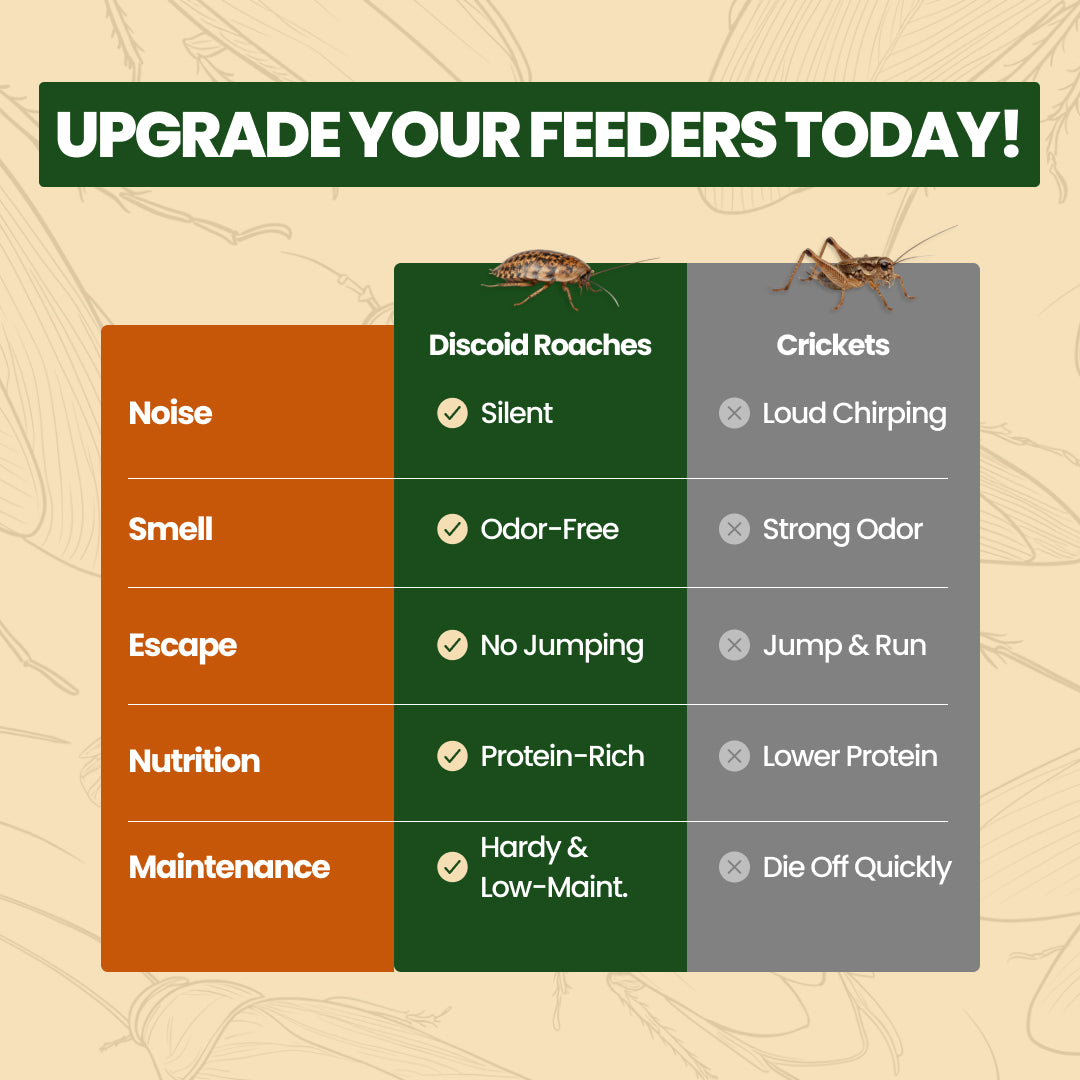
Crickets and mealworms are useful reference points here, because they sit at the opposite end of the regulatory spectrum from dubia roaches, and the reason why reinforces everything above. Both have been part of the commercial livestock and pet-feed supply chain in the United States for generations, are already produced and moved across state lines at massive scale as an established agricultural commodity, and have decades of real-world handling data showing no meaningful establishment or pest risk even at that scale. They were never evaluated as a new introduction risk in the way a comparatively newer feeder-trade species like dubia was — they're simply baseline, unrestricted livestock feed insects across nearly every state, Florida included. That's a different path to "no permit required" than the one discoid roaches took (naturalized presence rather than long agricultural-commodity status), but it lands in the same practical place: a feeder insect a Florida keeper can buy and use without a second thought.
Other roach species marketed as feeders — Turkestan roaches, red runner roaches, orange-head (lobster) roaches, and Madagascar hissing roaches among them — each have their own regulatory story shaped by the same factors: native range and climate match, dispersal ability, and whether they already have an established Florida presence. Some of those species are genuinely faster breeders or better climbers than either dubia or discoid roaches, which tends to push their risk assessment in a more cautious direction rather than a less cautious one. The practical takeaway for a Florida keeper considering any feeder roach beyond discoid or the well-known dubia case is the same one that applies throughout this article: check the specific species' current status with FDACS rather than assuming it follows the same pattern as a roach you've already researched.
Common Questions and Misconceptions
"If discoid roaches are legal, does that mean the state has approved them as harmless?" Not quite — "no permit required" reflects a risk assessment, not an endorsement. FDACS isn't vouching for discoid roaches as beneficial or certifying them in any positive sense; the classification simply means the agency's evaluation didn't find enough risk of ecological or agricultural harm to justify a permit requirement. That's a meaningful distinction if you're trying to understand what the legal status actually signals versus what it doesn't.
"Does 'legal in Florida' mean legal everywhere?" Not automatically. Every state runs its own non-native species regulations independently, and while discoid roaches are broadly permitted across the country, a keeper moving between states — or a business shipping interstate — should still confirm the destination state's specific rules rather than assuming Florida's classification travels with the shipment. Florida's system, built around FDACS and Chapter 5B-57, is specific to Florida; other states use their own agencies, statutes, and species lists that don't necessarily mirror it.
"Since discoid and dubia roaches are nutritionally identical, shouldn't they have the same legal status?" This is the single most common point of confusion, and it's worth restating plainly: nutritional and behavioral similarity as a feeder insect has nothing to do with how Florida evaluates ecological risk. The two species are excellent nutritional substitutes for each other and terrible regulatory analogues for each other, because the criteria that actually matter to FDACS — native range and climate match, dispersal ability, existing Florida history, agricultural pest potential — happen to diverge sharply between the two species despite their similarity in a feeding bin.
"Could discoid roaches' legal status change in the future?" In principle, yes — any species classification under Chapter 5B-57 can be revisited if new information emerges. In practice, a species with decades of documented, harmless naturalized presence in Florida represents about as stable a case as exists in this regulatory framework; a reclassification would require some new evidence of risk that isn't currently on record. That said, "in principle, yes" is exactly why this article points back to FDACS as the authoritative, current source rather than treating any single article — including this one — as a permanent legal reference.
What This Means for Breeders and Pet Stores
For anyone running a breeding operation or retail business in Florida, the practical upside of discoid roaches' no-permit status goes beyond just avoiding paperwork. It means a Florida-based breeder can scale a colony without the overhead of permit renewals, compliance inspections, or the containment-standard investment a conditional species would require. It means a pet store can stock discoid roaches as a primary feeder line without adding a regulatory compliance burden most small retailers aren't equipped to carry. And it means the entire supply chain — from breeder to retailer to end customer — moves faster and more simply than it would for a conditional species, where every link in that chain would need to independently verify its own compliance.
That's part of why discoid roaches have become the default "dubia alternative" across the Florida reptile-keeping community rather than one option among several. The regulatory clarity isn't just a legal footnote — it's a practical business and hobbyist advantage that shapes which feeder species actually gets built into long-term breeding programs, store inventories, and feeding routines across the state.
What a Discoid Roach Actually Looks Like — and Why It Matters Here
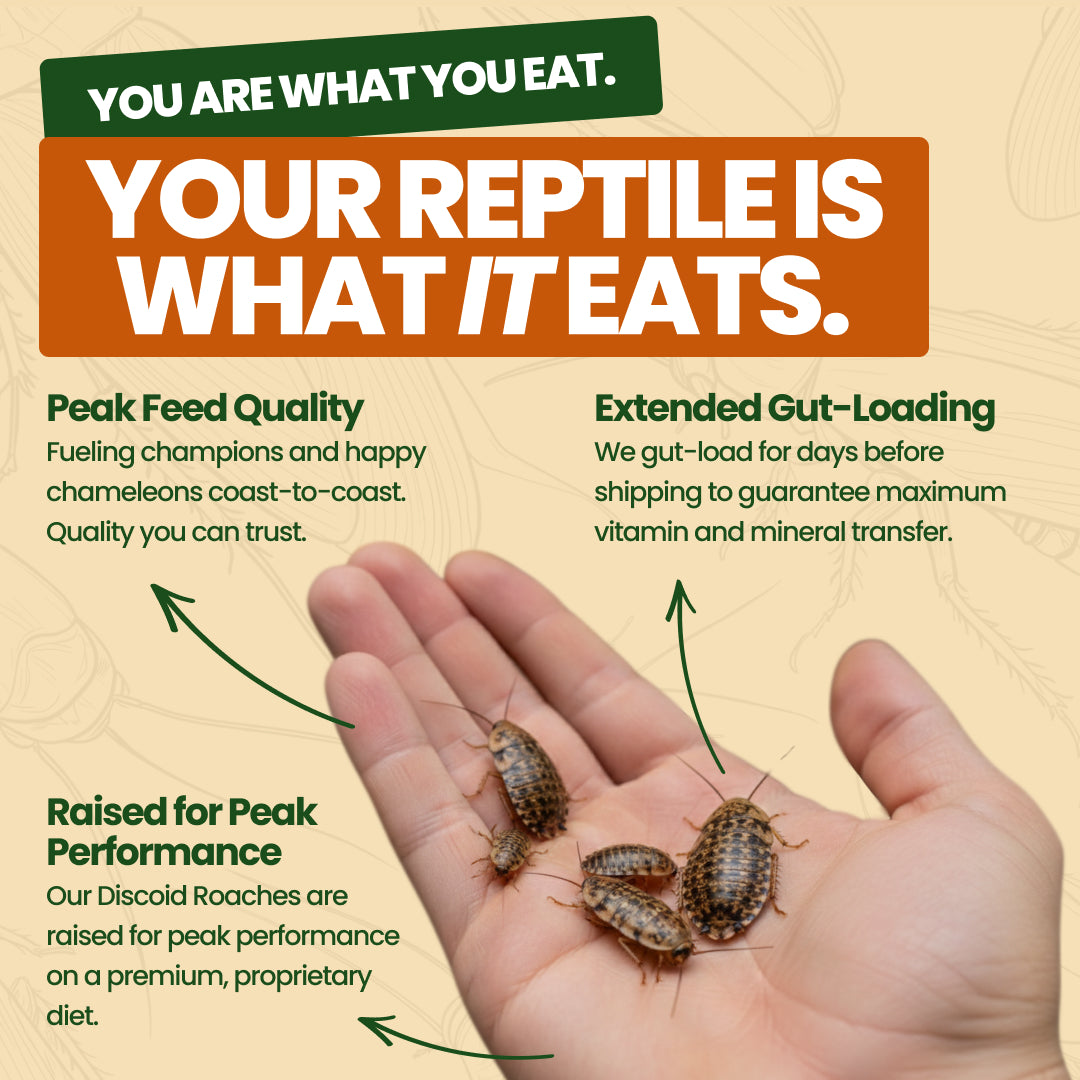
It helps to have a clear picture of the animal at the center of this whole regulatory question, because a few of its physical traits are directly relevant to the risk assessment described above, not just identification trivia. Adult Blaberus discoidalis reach roughly two inches in length, with a flattened, oval body typically brown to dark tan, often with a lighter band or gradient near the front edge of the wings that gives the species its "discoid" name. Males and females are distinguishable by wing length relative to the abdomen — males' wings extend to fully cover the abdomen, while females' wings leave the last segment or two exposed — a detail breeders use for colony management but that also reflects a broader point: this is a well-studied, well-documented species, not an obscure or poorly understood one, which is itself part of why regulators have a solid evidence base to work from rather than having to guess at risk.
Nymphs go through a series of molts on their way to adulthood, gradually developing the wing structures that remain non-functional for flight even once fully grown. That non-functional-wing detail is worth repeating in this context because it's not a minor footnote — it's one of the concrete, verifiable biological facts underpinning the "poor dispersal" argument that runs through this species' entire risk profile. A regulator evaluating establishment risk isn't working from a vague sense that the species "seems docile" — they're working from a specific, testable trait (no flight capability) that directly limits how far and how fast any escaped population could spread, the same way cold sensitivity directly limits how far north it could persist. Every argument in this article for why discoid roaches were not restricted traces back to physical, observable characteristics of the animal itself, not to assumptions or industry lobbying.
The Bottom Line
Discoid roaches are legal in Florida because Florida's actual regulatory question isn't "is this a roach" — it's "what happens if this specific species ends up loose outdoors at scale," evaluated by FDACS's Division of Plant Industry under Florida Statutes §581.083 and Rule Chapter 5B-57. On that question, discoid roaches score low risk for reasons that hold up under scrutiny: a documented, decades-long naturalized presence in the Caribbean and parts of Florida itself, an inability to fly or climb smooth surfaces that sharply limits real-world dispersal, cold sensitivity that caps how far any escaped population could spread, and no history of agricultural pest behavior anywhere in a native and naturalized range that spans multiple countries and climates. Dubia roaches, evaluated against the same criteria, came out differently — not because they're a "worse" feeder insect, but because their climate-matched South American range, strong breeding rate, and lack of Florida history added up to a risk profile the state chose to manage through permitting rather than open sale.
For Florida reptile keepers, that regulatory outcome has a simple practical upshot: discoid roaches are the feeder roach you can buy, breed, and keep without a second thought about compliance, while still delivering the same protein, fat, and moisture profile that made dubia roaches popular in the first place.
Last updated