
Hornworms
The Behavior of the Hornworm: A Scientific Look

A Solitary Animal With One Job
Where this site's companion piece on discoid roach behavior describes a gregarious, socially organized animal that actively seeks out other roaches, a hornworm's behavioral profile is almost the opposite: Sphingidae caterpillars, hornworms included, are overwhelmingly solitary. There's no aggregation drive, no pheromone-mediated clustering, no social structure of any kind at the larval stage — each caterpillar behaves as an independent feeding unit focused entirely on its own growth, with essentially no behavioral investment in the presence or absence of other caterpillars nearby. Multiple hornworms sharing a feeder cup aren't a colony in any meaningful behavioral sense the way a discoid roach group is — they're simply several independent animals occupying the same space because a keeper put them there, not because anything in their biology drives them to seek each other out.
That solitary orientation lines up with the single-minded priority covered in this site's companion anatomy piece: a caterpillar's entire behavioral repertoire is organized around feeding as efficiently as possible to fuel rapid growth, with almost nothing left over for social behavior, territory defense, or the kind of complex chemical communication roaches rely on.
The "Sphinx" Posture: Where the Family Name Comes From
When at rest or not actively feeding, hornworms characteristically raise and curl the front portion of the body — the head and first several thoracic/abdominal segments — into an upright, curved posture that gave the entire family Sphingidae its name, after a resemblance keepers and naturalists have long compared to the pose of the mythological sphinx. This isn't just a resting pose; published research on this species' nervous system has documented it as a distinct behavioral state, sometimes called the "quiescent" state, during which the caterpillar's normal defensive reflexes are actively suppressed rather than simply inactive by default — a real, measurable shift in the nervous system's readiness to respond to a threat, not just an absence of stimulus.
Defensive Behavior: A Real Repertoire, Not Just Freezing
Despite lacking the hard armor, speed, or bite strength that protects many other insects, hornworms have a genuinely documented set of defensive responses to a threat, described in the entomological literature as "nocifensive" behaviors — responses specifically triggered by a noxious or damaging stimulus like a pinch or predator strike, distinct from the passive quiescent resting state described above. Depending on where and how strongly a stimulus is applied, a hornworm's response can range from a partial, localized withdrawal or strike at the offending contact point up through much stronger whole-body reactions: rearing the front of the body up and away from the stimulus, and vigorous side-to-side thrashing of the trunk, which can be surprisingly forceful for a soft-bodied animal.
Regurgitating gut contents is another documented defensive response across this family when a caterpillar is handled roughly or feels threatened — an unpleasant-tasting deterrent aimed at a predator that's already made contact, rather than a distance-based warning the way the exhaled-nicotine defense covered in this site's nicotine-safety piece works. For a keeper, this is worth knowing simply so it isn't mistaken for illness: an occasional regurgitation response to being handled is a normal defensive reflex, not a sign something is wrong with the animal.
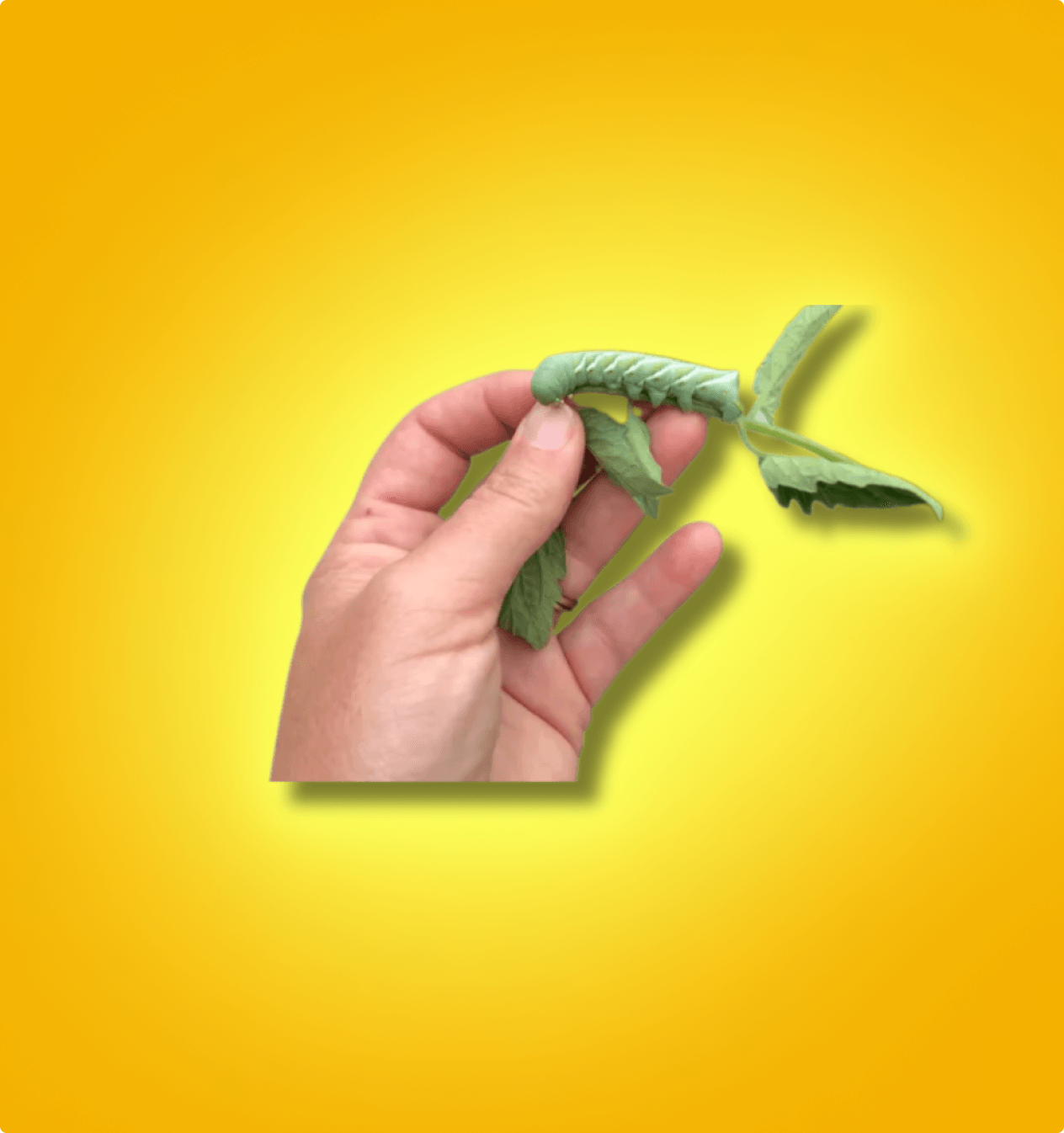
None of this defensive repertoire amounts to a genuine threat to a person or a reptile — there's no venom, no functional stinger despite the intimidating horn covered in this site's anatomy piece, and no bite capable of meaningfully harming a human handler. It's a real, evolved defensive toolkit, just one built around startling and deterring rather than actually injuring whatever's threatening it.
Feeding Behavior: Continuous and Single-Minded
A hornworm's feeding behavior is close to constant during active growth phases, punctuated mainly by the brief pauses required for each molt. Unlike a discoid roach's nocturnal-only activity pattern (covered in this site's companion roach-behavior piece), hornworms feed across both day and night with less of a sharply defined activity window, though many caterpillar species, including hornworms, show somewhat elevated feeding activity around dusk and into the night. The behavior itself is mechanically simple and repetitive — locate edible material via the contact chemoreception described in this site's anatomy piece, grip it with the thoracic true legs, and consume it steadily using the mandibles — but the sheer continuity of it, day after day with minimal interruption, is what drives the dramatic growth rate that makes hornworms such a fast-outgrowing feeder relative to their short usable window.
The "Wandering" Behavior That Signals Pupation Is Coming
One of the most behaviorally distinct sequences in this species' life is the transition out of the feeding stage entirely, and it's a genuinely stereotyped, well-documented behavioral program rather than a vague slowdown. Feeding activity declines sharply over roughly an eight-hour period as the caterpillar approaches its final larval size. The animal then coats its body surface with a secretion from glands near the mouthparts, and enters what researchers call "wandering" behavior — an extended period, roughly ten to thirty hours, of active, purposeful movement away from the food source in search of a suitable site to pupate, historically in loose soil where the caterpillar can dig down and construct an underground pupation chamber.
This wandering phase is triggered on a specific internal schedule governed by the animal's circadian timing system — it isn't a random or gradual drift but a distinct behavioral gate that opens at a particular point in the animal's development and daily cycle. Practically, this is the exact behavior described in this site's care content as the sign a hornworm is approaching pupation and past its ideal feeding window: a caterpillar that was recently feeding steadily and is suddenly moving with unusual purpose around the container, seemingly searching for an exit or a place to burrow, has very likely entered this wandering phase, not escaped or become distressed for an unrelated reason.
Following the wandering phase, the animal enters a further transitional stage called the pre-pupa, during which it visibly shrinks and its movement slows dramatically as internal tissues reorganize in preparation for the pupal molt — the final behavioral checkpoint before the dramatic internal transformation into a sphinx moth covered in more anatomical detail in this site's companion piece on hornworm anatomy.
How a Hornworm Finds Food Without Real Vision
Given the minimal visual system described in this site's companion anatomy piece — simple light-detecting eyespots rather than true image-forming compound eyes — a hornworm's food-location behavior relies almost entirely on contact chemoreception and, to a lesser degree, olfaction: sensory hairs and structures on the mouthparts and head detect specific plant chemical cues on contact or at very short range, guiding the animal toward and onto edible material. In the wild, this system is tuned toward detecting the specific chemical signature of nightshade-family foliage, part of what makes this species such a specialist herbivore on that plant family in the first place. In a commercial rearing setup, the same basic sensory system responds to the chemical cues in formulated chow rather than a living leaf, which is functionally sufficient even though it's a very different substrate than what the species evolved to detect.
This heavy reliance on close-range chemical and tactile sensing rather than vision is also why a hornworm's behavior in a feeder cup looks the way it does to an observer: steady, methodical, close-contact feeding on whatever's immediately in front of it, without anything resembling active visual searching or scanning behavior. It's a food-location strategy built for a world experienced mostly through touch and taste, not sight.
Startle Response in Practice: What a Keeper Actually Sees
Translating the documented nocifensive repertoire above into what actually happens when a keeper picks up or handles a hornworm: a light touch typically produces little to no reaction, consistent with the quiescent "sphinx" state being the animal's default posture when undisturbed. A firmer grip or sudden contact — especially near the head or horn — more often triggers a visible response: the front of the body lifting and curling away from the contact point, sometimes accompanied by brief side-to-side thrashing, and occasionally a small amount of regurgitated gut fluid at the mouth. All of this is normal defensive behavior, not a sign of injury or illness, and it typically stops within seconds once handling stops and the animal is left undisturbed. Gentle, minimal handling — supporting the body rather than pinching or restraining it — produces noticeably less of this response than rough handling does, which is worth knowing both for the animal's sake and simply because a calm hornworm is easier to work with than one actively thrashing.
What This Means for Keepers
Every practical hornworm-handling note already published across this site traces back to a behavior described above: no social/aggregation needs to plan housing around, since this is a solitary species with no colony structure; occasional regurgitation or thrashing when handled is a normal defensive reflex, not illness; and unusually purposeful, exploratory movement in a container that was previously calm and feeding steadily is very likely the wandering behavior that precedes pupation, not distress or an enclosure problem. Understanding the behavior explains the husbandry guidance rather than requiring it to be memorized as an arbitrary rule.