
Hornworms
Are Hornworms Fed on Tobacco Toxic? The Nicotine Question, Explained

The Short Answer
Hornworms sold as feeder insects — including every hornworm All Angles Creatures ships — are raised on a formulated artificial diet, not tobacco or tomato leaves, so there is no nicotine or nightshade-toxin exposure to worry about. The nicotine question exists because the animal commonly sold as a "hornworm" feeder is the same species (or a close relative) known in gardens as the tobacco hornworm or tomato hornworm, and that species has a genuinely remarkable, scientifically documented relationship with nicotine when it does eat nightshade plants in the wild. Understanding that relationship — and specifically why it doesn't apply to a store-bought feeder cup — is worth doing properly rather than waving away, because the honest answer has real nuance most one-line reassurances skip.
One Species, Two Very Different Diets
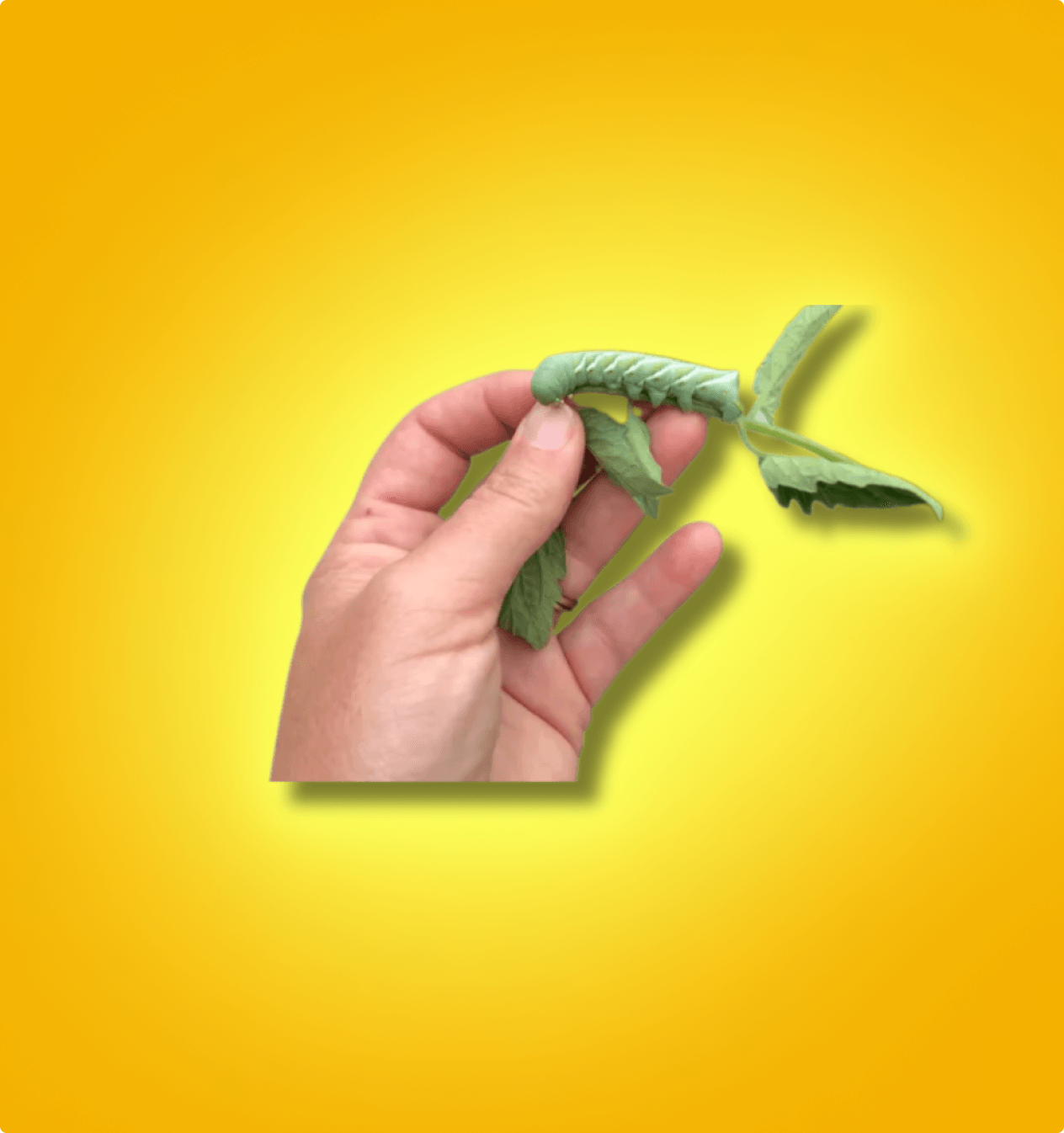
The hornworms sold across the reptile feeder trade are caterpillars of Manduca sexta (the tobacco hornworm) or the closely related Manduca quinquemaculata (the tomato hornworm) — large, sphinx-moth caterpillars in the family Sphingidae. In the wild, and in a home vegetable garden, these caterpillars are specialist feeders on nightshade-family plants (Solanaceae): tobacco, tomato, potato, pepper, and other related species. That's exactly where the common names come from, and it's also exactly why a hornworm found eating your tomato plants shouldn't be assumed safe to feed to a pet.
Commercially raised feeder hornworms — the ones shipped in a deli cup sitting on a bed of chow — are the same species, but they never touch a nightshade plant at any point in their life. From the moment they hatch, they're fed a formulated artificial diet built around wheat germ, soy, and agar (sometimes with added vitamins and other plant-derived ingredients, but never tobacco, tomato, or other nightshade foliage). This isn't a minor detail — it's the entire reason the nicotine question resolves the way it does for a purchased feeder. The caterpillar's biology hasn't changed, but its actual diet has, and diet is what determines whether any nicotine is present to begin with.
Why Nightshade Plants Are Toxic in the First Place
Nicotine is a plant-produced neurotoxin — tobacco and its nightshade relatives evolved it as a defense against the very insects (and other herbivores) that would otherwise eat them. At the concentrations present in tobacco leaves, nicotine is potent enough to kill most insects that attempt to feed on the plant, which is exactly why it's historically been used as an agricultural insecticide. Tomato and potato foliage carry a related but chemically distinct defense — glycoalkaloids like tomatine and solanine, also toxic to a wide range of animals including humans in sufficient quantity (the reason tomato and potato leaves, as opposed to the fruit, aren't eaten as food).
Almost every insect that attempts to feed on these plants is either killed or driven off by these defenses. Manduca sexta and its close relatives are a rare, specific exception — a lineage of caterpillars that evolved the biochemical machinery to feed on nicotine-laden tobacco leaves and survive, which is precisely why they've become such a well-known, persistent garden pest on tobacco and tomato crops specifically. That resistance is a genuinely interesting evolutionary story on its own, and it's the reason a wild-diet hornworm's relationship with nicotine is worth understanding in more depth than "it's resistant, so it's fine."
How Manduca Sexta Actually Handles Nicotine
Peer-reviewed research (published in the Proceedings of the National Academy of Sciences) has identified the specific mechanism behind this species' nicotine tolerance, and the finding is more interesting than simple detoxification. A midgut-expressed enzyme, encoded by a gene called CYP6B46, is upregulated when the caterpillar feeds on nicotine-containing plant tissue. Researchers using RNA interference to silence this gene found that it's required for a small fraction of ingested nicotine — about 0.65% of what's consumed — to move from the digestive tract into the hemolymph (the insect's circulatory fluid), from which it's then exhaled outward through the spiracles, the small breathing openings along the body wall covered in this site's companion piece on discoid roach anatomy (a body plan broadly shared with caterpillars, adapted to their own physiology).
That exhaled nicotine turns out to serve an active defensive purpose rather than being a waste byproduct: when the gene was silenced and caterpillars stopped exhaling nicotine, they became substantially easier prey for wolf spiders in controlled trials — the nicotine-scented breath functions as a genuine chemical warning signal, something researchers described as a form of "defensive halitosis" that helps deter at least one class of natural predator. The vast majority of ingested nicotine — the other 99%-plus — isn't circulated through the body this way; it largely passes through the digestive tract and is excreted in frass (caterpillar waste) rather than being stored in body tissue at high concentration.
Tomatine: The Other Nightshade Toxin Worth Knowing About
Nicotine gets most of the attention because of the tobacco connection in the common name, but a hornworm feeding on tomato or potato foliage in a garden is dealing with a different plant defense chemical entirely: tomatine, a glycoalkaloid concentrated in the leaves and stems of nightshade-family plants (present at much lower levels in ripe tomato fruit itself, which is why the fruit is safely edible while the foliage isn't). Tomatine has its own distinct toxicity profile from nicotine — it's not a nerve toxin the way nicotine is, but it disrupts cell membranes and has documented antifungal and anti-feedant effects against a wide range of organisms.
Manduca quinquemaculata, the tomato hornworm specifically, has its own evolved tolerance mechanisms for tomatine, broadly parallel to how M. sexta handles nicotine — different toxin, similar evolutionary story of a specialist herbivore developing resistance to its host plant's defenses. The practical implication is the same one that applies to nicotine: a caterpillar's own resistance to a toxin doesn't mean that toxin has vanished from its body, and a predator eating that caterpillar isn't automatically protected by the caterpillar's own resistance mechanism.
Does This Mean a Wild Hornworm Is Safe to Feed?
No — and this is the point where the science needs to translate into a practical caution rather than a false reassurance. Even though the resistance mechanism means Manduca sexta isn't killed by nicotine the way most insects would be, and even though most ingested nicotine passes through rather than accumulating, a wild-caught tobacco or tomato hornworm actively feeding on nightshade foliage still has real nicotine present in its gut contents and a documented (if small) amount actively circulating in its hemolymph at the moment you'd catch it. Layer onto that the tomatine and other glycoalkaloids present if it's feeding specifically on tomato or potato rather than tobacco, plus the basic problem that a garden-caught caterpillar's exact diet history, species identification, and pesticide exposure are all unknown and uncontrolled — and "the caterpillar itself won't die from what it ate" is a very different claim from "it's safe to feed to a bearded dragon or leopard gecko."
This is the actual, evidence-grounded reason to never feed wild-caught garden hornworms to a pet reptile or amphibian, regardless of how convenient it might seem to just pluck one off a backyard tomato plant. It isn't superstition or an overcautious rule of thumb — it's a direct consequence of what this species' diet-dependent toxin exposure actually looks like in the wild.
Why Commercially Raised Hornworms Sidestep the Whole Question
A commercially raised feeder hornworm never enters the causal chain described above, because it's never eaten a nightshade leaf. The entire nicotine-exposure pathway depends on the caterpillar's diet containing nicotine in the first place — no nicotine in the chow means no nicotine absorbed, no nicotine in the hemolymph, and nothing for the CYP6B46 pathway to act on even though the caterpillar retains the genetic and enzymatic capacity to handle it if it were exposed. The formulated wheat-germ/soy/agar diet that commercial hornworm operations use exists precisely to produce a nutritionally consistent, toxin-free feeder — it isn't marketed primarily as a "nicotine-safety" measure, but it functions as one as a direct side effect of what's actually in (and not in) the recipe.
This is also why a hornworm's bright blue-green coloration and size are reliable, easy visual identifiers for a chow-raised feeder versus a garden specimen: commercial hornworms are raised in controlled, consistent conditions from hatch, producing the uniform coloration and size grading seen in a feeder cup, while wild garden hornworms vary more in size, coloration, and condition depending on what and how long they've actually been feeding outdoors.
This Isn't a One-Off: Monarch Butterflies Do Something Similar
The broader phenomenon here — an insect eating a toxic plant, tolerating the toxin, and repurposing it for its own defense — is well documented across entomology, and the tobacco hornworm's nicotine story sits alongside a more famous parallel: monarch butterfly caterpillars, which feed exclusively on milkweed and sequester the plant's cardenolide toxins directly into their own tissue, retaining them through metamorphosis into the adult butterfly. That sequestered toxin load makes monarchs genuinely poisonous to many vertebrate predators, which is why monarch coloration functions as a well-studied warning signal (aposematism) that birds learn to avoid.
The tobacco hornworm's strategy is a meaningfully different variant — a smaller, actively exhaled defensive signal rather than whole-body toxin storage, and aimed specifically at a documented predator (wolf spiders) rather than functioning as a broad visual warning the way monarch coloration does — but both examples make the same underlying point: "this insect eats a toxic plant and isn't harmed by it" doesn't mean the toxin has disappeared from the equation. In both cases, the toxin is still present and biologically active; the insect has simply found a way to survive it and, in some cases, turn it into a tool of its own. Understanding that pattern is what makes the hornworm-and-nicotine question answerable with actual reasoning rather than a guess.
How to Tell a Garden Hornworm From a Feeder Hornworm
Visual identification isn't a reliable safety check on its own — a garden-caught hornworm and a commercially raised feeder can look broadly similar at a glance — but a few practical signals are still worth knowing for anyone tempted to supplement a store-bought batch with a "free" caterpillar off a tomato plant. Wild hornworms tend to show more variation in size and coloration within a group than a commercially raised batch, since garden conditions (food availability, temperature, competition) aren't controlled the way a chow-cup environment is. A garden specimen may also be host to parasitic braconid wasp larvae — visible as small white cocoons studding the caterpillar's back — a completely separate risk from the nicotine question but another reason wild-caught specimens carry unknowns a purchased feeder doesn't.
None of this amounts to a reliable field test, though, which is exactly the point: the only genuinely reliable way to know a hornworm has zero nightshade-toxin exposure is to know its full diet history, and that's only knowable for an animal raised under controlled conditions from hatch — which is precisely what a commercial feeder-insect operation, All Angles Creatures included, actually provides. The safety claim isn't "we've tested each hornworm for nicotine" — it's the simpler and more verifiable "this animal has never had access to a nightshade plant," which removes the entire question at the source rather than needing to check for it after the fact.
The Practical Rule
Buy feeder hornworms from a supplier that raises them on formulated chow — which is the standard, near-universal practice across the commercial feeder-insect trade, not a premium or unusual claim — and there's no meaningful nicotine or nightshade-toxin exposure to consider. Never feed a wild-caught hornworm pulled off a tomato, tobacco, potato, or pepper plant to a pet, no matter how similar it looks to a purchased feeder, because its actual diet history (and therefore its actual toxin load) is unknown and can't be verified by appearance alone. That single practical rule is the entire actionable takeaway from a genuinely fascinating piece of insect physiology — a species that evolved the ability to weaponize a plant's own defense chemical against its own predators, sidestepped entirely for a feeder insect that's simply never been exposed to that chemical in the first place.