
Discoid Roaches
The Nutritional Biochemistry of the Discoid Roach

Beyond the Label: What the Numbers Actually Mean
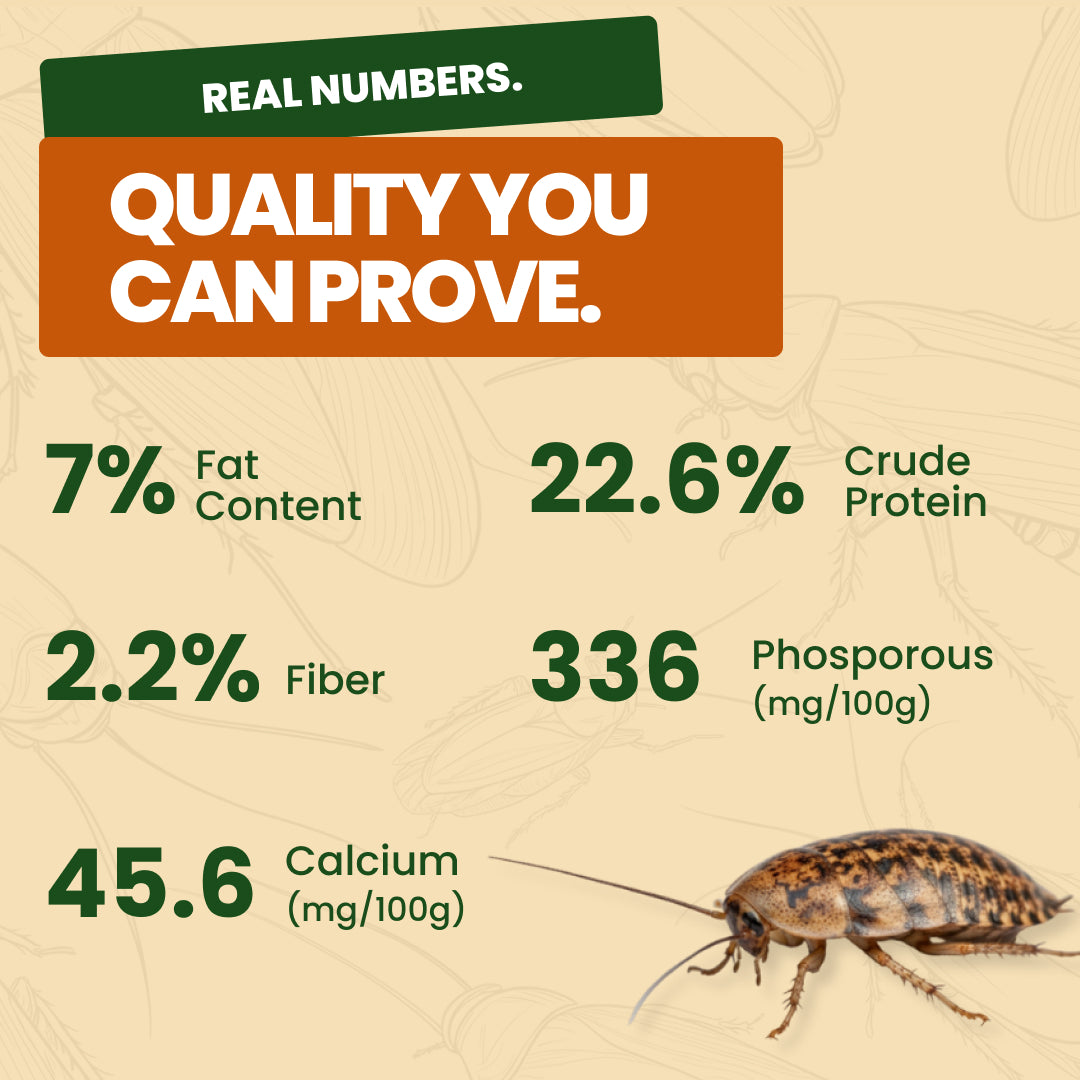
Every discoid roach product listing on this site carries the same four numbers: roughly 20% protein, 7% fat, 65% moisture, and a 0.77:1 calcium-to-phosphorus ratio. Those figures are accurate and useful for a quick comparison against other feeders, but they're also a compressed summary of a much more interesting underlying biochemistry — what that protein is actually made of, why the fat fraction matters more than its size suggests, what the "moisture" figure glosses over about hydration physiology, and why the calcium-to-phosphorus ratio specifically, rather than the raw calcium number, is the figure that matters for reptile bone health. This piece unpacks the biochemistry behind the label, using published nutritional analyses of roach species (Blattodea generally, since that's where the peer-reviewed composition data exists) alongside the verified figures specific to discoid roaches.
The Protein Fraction: What Amino Acids Are Actually Present
"20% protein" describes a quantity, not a composition — and composition is what actually determines nutritional value, because a reptile's body needs specific amino acids, not protein as an undifferentiated mass. Published amino acid analyses of roach species used as feed insects show a profile dominated by glycine and alanine, present at notably high levels compared to many other amino acids, alongside strong representation of lysine and valine — both essential amino acids a reptile can't synthesize on its own and must obtain from diet. Where roach protein is comparatively weaker is in the sulfur-containing amino acids, methionine and cysteine, which show up at meaningfully lower levels than the other amino acids in the profile.
That specific gap — strong on glycine, alanine, lysine, and valine, weaker on methionine and cysteine — is the actual biochemical justification behind advice you'll see across the reptile-keeping community to rotate between multiple feeder species rather than feed any single insect exclusively for years on end. It's not a vague "variety is good" platitude; it's that different feeder insects have different amino acid gaps, and rotating feeders is a practical way to cover a wider spread of essential amino acids over time than any single species' protein profile provides on its own.
The Fat Fraction: Fatty Acid Composition, Not Just Quantity
The ~7% fat figure is low relative to fattier feeders like superworms or waxworms, which is the number most keepers care about for weight management. But the composition of that fat fraction matters too. Roach fat has been documented as dominated by oleic acid (a monounsaturated fatty acid, the same one that makes up most of olive oil's fat content), with meaningful linoleic acid (a polyunsaturated omega-6 fatty acid) and palmitic acid (a saturated fatty acid) alongside it. Linoleic acid specifically is an essential fatty acid — reptiles, like most animals, can't synthesize it and need to obtain it from diet, where it plays a role in cell membrane structure and inflammatory signaling pathways. A feeder insect that's simply "low fat" without also providing some essential fatty acid content would be a less complete feeder than one that's low in total fat while still supplying a genuine fatty-acid profile — which is the more accurate way to describe what a lean-but-not-fat-deficient discoid roach is actually offering nutritionally.
The Moisture Figure: More Than Just Water Content
The ~65% moisture figure is easy to read as a simple hydration number — a wetter feeder helps a reptile drink less directly from a water dish — and that's true as far as it goes, but it undersells what's happening physiologically. Water inside living tissue isn't inert; it's bound up in cellular processes, present in blood-equivalent hemolymph, and distributed through the muscle and organ tissue a reptile is actually digesting, not sitting as free liquid the way water in a bowl does. A feeder insect's moisture content is delivered gradually through digestion alongside the nutrients it's bundled with, rather than absorbed all at once the way drinking does — which is part of why moisture-rich feeders are specifically valuable for species and life stages prone to dehydration (hatchlings, recovering or ill animals, species from humid native ranges), not just a generic hydration bonus applicable equally to every keeper's situation.
It's also worth noting what the moisture figure implies about the rest of the composition: at roughly 65% water by weight, the 20% protein and 7% fat figures already reflect the wet-weight reality of a living insect, not a dried or processed feed. That's the relevant comparison point for a keeper feeding live insects — the numbers on this site's product pages describe the animal as it's actually consumed, not a dehydrated or rendered meal-form product where the same nutrients would show up as a much higher percentage simply because the water's been removed.
Chitin: Fiber, Armor, and a Genuine Nutritional Trade-Off
Chitin — the structural polysaccharide that makes up the procuticle layer of the exoskeleton described in this site's companion anatomy piece — is functionally the fiber component of an insect-based diet. It's a complex carbohydrate, not digestible or usable as an energy source the way starch is, and its nutritional role is more complicated than simply "roughage."
Insectivorous reptiles are genuinely better equipped to handle chitin than herbivores or generalist omnivores are, because they've evolved endogenous chitinase enzymes — digestive enzymes that specifically cleave the chitin polymer into smaller, more manageable fragments. That said, digestibility isn't complete: published research on the calcium-rich portion of insect exoskeleton has found it often passes through the digestive tract largely intact, with digestibility coefficients well under 50% in some studies. There's also a documented trade-off worth knowing about — chitin has a binding affinity for proteins, meaning a meal with a high chitin-to-flesh ratio can actually reduce the bioavailability of some of that meal's own protein content, since some protein ends up bound to indigestible chitin rather than freely available for absorption.
This is one of the more concrete biochemical reasons appropriately sized feeders matter beyond simple "can it fit in the mouth" logistics: a smaller-bodied nymph or juvenile roach has a lower exoskeleton-to-body-mass ratio than a full adult, meaning proportionally less chitin and proportionally more digestible tissue per feeding — part of why undersized reptiles fed appropriately small roach sizes get more usable nutrition per feeding than the same total weight of oversized, harder-shelled prey would provide.
Calcium, Phosphorus, and Why the Ratio (Not the Raw Number) Matters
Discoid roaches carry a verified calcium-to-phosphorus ratio of 0.77:1 — meaning, in practical terms, there's slightly less calcium than phosphorus by weight. Published nutritional surveys across other roach species have documented calcium-to-phosphorus ratios spanning a much wider range, some closer to parity and some considerably more phosphorus-heavy, which underscores that this ratio isn't a fixed property of "roaches" as a category — it varies meaningfully species to species and is worth knowing for the specific feeder in front of you rather than assumed.
The ratio matters more than either raw number in isolation because of how calcium and phosphorus metabolism interact: phosphorus in the diet can interfere with calcium absorption when it's present in excess relative to calcium, and a diet that runs consistently phosphorus-heavy without correction is a direct contributor to metabolic bone disease in reptiles — one of the most common and most preventable health problems in captive insectivorous and omnivorous species. A calcium-to-phosphorus ratio at or below roughly 1:1, as discoid roaches carry, means the feeder itself isn't actively working against a keeper's supplementation efforts, but it also means dusting with a calcium supplement at feeding time isn't optional armchair advice — it's compensating for a real, measurable gap between the ratio the feeder provides and the ratio (generally recommended in the range of 1.5:1 to 2:1 or higher for growing and breeding reptiles) that reptile physiology actually needs.
Gut-Loading: What's Actually Happening Biochemically
Gut-loading — feeding a roach a nutrient-dense diet in the 24 to 72 hours before it's offered to a reptile — works because of a straightforward digestive-tract mechanic: whatever nutrient content is sitting in the insect's gut at the moment it's eaten gets passed along to the predator as part of that meal, on top of the insect's own baseline tissue composition. This isn't a marketing framing; it's been measured directly. Published research comparing gut-loaded versus non-gut-loaded feeder insects has found measurably higher circulating and stored vitamin A levels in reptiles fed the gut-loaded group, direct evidence that the nutritional content passed through the feeder's digestive tract at the time of feeding, not just the feeder's own body composition.
The practical implication is that a roach's baseline nutritional profile — the 20/7/65 figures and the amino acid and fatty acid composition described above — is really a floor, not a fixed ceiling. What that roach ate in its last day or two before being offered as a feeder measurably shifts what a reptile actually receives, which is the biochemical reason gut-loading with calcium-rich greens and varied produce genuinely improves feeding value rather than being a husbandry nicety with no real nutritional effect.
Why Nutrient Content Shifts Across Life Stages
Nutritional composition isn't static across a roach's life cycle. Published analyses comparing adult and subadult roaches have found adults running measurably higher in crude protein and correspondingly lower in fat than subadults, a pattern consistent with the general biological principle that younger, still-growing animals typically carry more stored energy reserve (fat) relative to structural tissue (protein) than mature adults do, whose growth has largely finished and whose fat reserves are used more for reproduction and short-term energy buffering than for building new tissue. This is part of the biochemical backing behind the practice of matching roach size and life stage to a reptile's own life stage — a smaller, subadult roach isn't just easier to fit in a smaller mouth, it also carries a measurably different macronutrient balance than a full adult of the same species.
How This Compares Across Common Feeders
Placing discoid roach biochemistry against other common feeders makes the trade-offs concrete rather than abstract. Against crickets, discoid roaches carry a comparable protein percentage but with the amino acid strengths and gaps described above rather than an identical profile — part of the biological case for rotation rather than a pure substitution. Against fattier feeders like superworms and waxworms, discoid roaches' leaner fat fraction (and the more essential-fatty-acid-forward composition of that smaller fat fraction) makes them a better staple-feeding choice for species prone to obesity, while the fattier feeders retain real value as occasional, calorie-dense offerings for underweight animals, breeding females, or species with genuinely higher fat tolerance. Against dubia roaches specifically, the macronutrient profile is close enough to be treated as nutritionally interchangeable in practice — the meaningful difference between the two species covered elsewhere on this site is regulatory, not nutritional.
The broader point a keeper should take from any of these comparisons is that no single feeder insect — discoid roaches included — is a nutritionally complete standalone diet on its own amino acid and fatty acid merits. The realistic path to covering a reptile's full nutritional needs is the combination already standard across serious reptile husbandry: a size- and life-stage-appropriate staple feeder, periodic rotation or supplementation with other feeder species, calcium and vitamin dusting timed to feeding, and a well-managed gut-loading regimen — each addressing a different specific gap the biochemistry above makes visible rather than leaving as an assumption.
What This Means in Practice
None of this changes the basic feeding guidance already published across this site — appropriately sized roaches, dusted with calcium, offered from a gut-loaded, well-cared-for colony, at a frequency matched to the reptile's age and species. What the biochemistry adds is the "why" underneath the "what": rotating feeder species covers amino acid gaps a single species' profile doesn't fill on its own; dusting with calcium compensates for a real, measurable phosphorus-heavy ratio rather than an assumed one; gut-loading works because nutrients genuinely pass through the digestive tract into the meal, not as a symbolic gesture; and matching roach size to reptile life stage has a real macronutrient basis, not just a mechanical fit-in-the-mouth one. The label numbers are accurate. They're just the summary — the biochemistry is the actual explanation.