
Reptilia · Squamata
Python regiusShaw, 1802
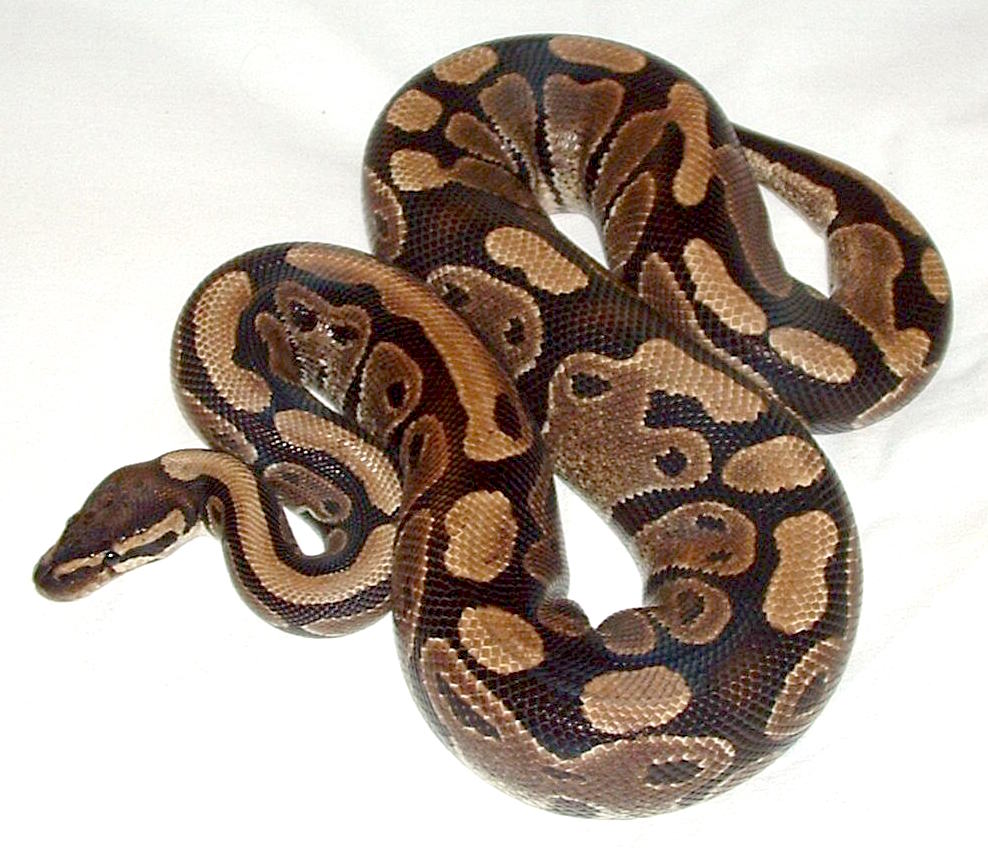
Ball Python
Photograph by HCA (talk), CC BY-SA, via Wikimedia Commons

A ground-dwelling, nocturnal, meat-eating snake from the Afrotropic region, reaching 180 cm nose to tail.
Also called Royal Python.
Reptilia › Squamata › Pythonidae › Python
- Grows to
- 1800mm
- greatest recorded
- Eats
- Carnivorous
- Active
- Nocturnal
- Lives up to
- 62years
Longer than only 16% of all pythons anyone has measured.
The bar is the rank itself: its length is the share of the family this animal exceeds. The chart below is the family’s real spread, on a logarithmic scale because body length here runs from 750 to 7,900 mm. The solid rule is this animal. Every bar is a count of real species, and nothing on this figure is estimated.
What is known
42 sourced facts, each taken from a named scientific dataset. How to read these.
Cited from a dataset unless a row is marked otherwise.
Two of these figures disagree
Body mass (a typical adult) is given as 8,858, and Body mass (greatest) as 2,612.1 — but a typical adult cannot outweigh the heaviest one ever recorded. They come from different sources and both are shown exactly as those sources give them.
Standing in the world
- Still living
- Extant
- Conservation status
- Near Threatened
- Status assessed · the year the Red List last looked
- 2020
- Population trend
- Decreasing
- Red List criteria
- A2d+3d+4d
The animal itself
- Limbs
- None
- Pupil
- Vertical slit
- Venomous
- No
- Fangs
- None
- Longest recorded life
- 62years
50 (Stark et al. 2020), a snake received as adult died 59.5 years later (Dawson et al. 2022 who add "we estimate the snake was a minimum of 62 y old in total" - reasonable given it maures in 3 years)
Size
- Length snout to vent · greatest recorded
- 1125mm3 ft 8 in
- Length nose to tail · greatest recorded
- 1800mm5 ft 11 in
- Hatchling length · nose to tail
- 385mm15 in
- Body mass at hatching
- 94.07g3.3 oz
- Body mass · greatestcomputeddisputed
- 2612.1g5.8 lb
- Body mass · a typical adultdisputed
- 8858g20 lb
snakes only in this source
computed from length by a family-level allometric equation, not weighed
AnAge rates this record "acceptable"
How it lives
- Diet
- Carnivorous
- How it hunts
- Sit and wait
- Active
- Nocturnal
- Where it lives
- Terrestrial
- Habitat
- Forest
- Biome
- Tropical & Subtropical Grasslands, Savannas & Shrublands
- Region
- Afrotropic
- Mainland or island
- Mainland
- Highest it lives · above sea level
- 1200m
- Range size
- 4,778,024km²
birds and mammals (Barends and Naik 2023, Spawls et al. 2023), small mammals (Trape 2023)
Sit (Glaudas et al. 2019)
(Stark et al. 2018, O'Shea 2018, Spawls et al. 2023), occasionally basks (Spawls et al. 2023)
Scharf et al. 2015
650-1200 (Spawls et al. 2018), 0-1000 (O'Shea 2018), max 400 (Reed 2005)
Breeding
- Reproduction
- Oviparous
- Sex decided by
- Genes, XX/XY
- Gestation or incubation
- 77days
- Average clutch
- 7eggs
- Eggs or young per clutch
- 1–18eggs
- Mean clutch
- 7eggs
- Clutches in a year
- 0.55per year
- First breeds at
- 36months
- Age at first breeding · female
- 1825days
Feldman et al. 2015
mean 7 (Scharf et al. 2015), 1-10 (Chippaux and Jackson 2019), max=16 (Murphy et al. 2003), 5-15 (O'Shea 2018), max 15 (Reed 2005), 1-18 (Spawls et al. 2023)
Naming and history
- Suborder
- Serpentes
- Infraorder
- Alethinophidia
- Subspecies
- No
- Described by
- Shaw
- Moved to another genus · since it was first described
- Yes
- Described in
- 1802
- Type locality
- Unknown
Keeping one
5 ft 11 in × 2 ft 11 in × 4 ft 5 in(180 × 90 × 135 cm)
Minimum length × width × height, for one animal. Bigger is always better.
The standard sizes snakes as a fraction of total length: 1 × 0.5 × 0.75.
Mindestanforderungen an die Haltung von Reptilien (Sachverständigengutachten), German Federal Ministry for Nutrition, Agriculture and Forestry, Animal Welfare Division, 10 January 1997. The standard states these floor areas are recommendations rather than binding limits.
From this animal’s own total length of 5 ft 11 in (1800 mm), at 1 × 0.5 × 0.75 times it, following the German federal welfare standard — how this is worked out.
No preferred body temperature has been recorded for Ball Python. Rather than repeat a number from a care sheet, this page leaves it out.
Feeding
A prey item should be between the same width as the widest part of the snake's body and about 1.5 times that width.
Widely used across snake husbandry references. An alternative formulation gives prey at 10-15% of the snake's body mass. This is established practice, not a measurement.
214kJ per day
Worked out for an animal of 2,612 g, the heaviest recorded for Ball Python — so it is the top of the range, not a figure for a particular animal. Weigh yours and the number will be lower.
An upper estimate, not a feeding target, and not veterinary advice. The equation covers only what an animal burns staying alive, so a growing, gravid or recovering animal needs more — and it was measured on wild animals, which move far more than one in an enclosure. Body condition and a vet who knows the species are what a feeding decision should rest on. Where this comes from.
Morphs
11 with peer-reviewed genetics behind them, 15 resting on breeder consensus. Most references present both with the same confidence.
What each pairing produces → · Two genes at once →
- Albinismpeer reviewed
- A community-science approach identifies genetic variants associated with three color morphs in ball pythons (Python regius). — PLoS One 2022
- Differentiation between wild type and heterozygous albino ball pythons (Python regius) by PCR and qPCR. — Braz J Biol 2024
Lacks black pigment, leaving yellow and white with pink or red eyes.
García-Elfring et al. (2025): "Wild-type ball pythons have a black background with tan saddles and traces of yellow ... . In non-axanthic individuals, yellow pigment overlaps tan saddles but is absent from dark regions ... , whereas axanthic pythons lack yellow but retain wild-ty
- GTP cyclohydrolase II (gch2) and axanthism in ball pythons: A new vertebrate model for pterin-based pigmentation. — Anim Genet 2025
- A frameshift variant in the melanophilin gene is associated with loss of pigment from shed skin in ball pythons (Python regius). — MicroPubl Biol 2023
Albino with a lavender-grey background rather than white.
Patches of unpigmented white skin between areas of normal pattern.
- Skin colourpeer reviewed
- Piebaldism and chromatophore development in reptiles are linked to the tfec gene. — Curr Biol 2023
- A community-science approach identifies genetic variants associated with three color morphs in ball pythons (Python regius). — PLoS One 2022
- Stripes and loss of color in ball pythons (Python regius) are associated with variants affecting endothelin signaling. — G3 (Bethesda) 2023
- A ball python colour morph implicates MC1R in melanophore-xanthophore distribution and pattern formation. — Pigment Cell Melanoma Res 2025
- Piebaldism and chromatophore development in reptiles are linked to the tfec gene. — Curr Biol 2023
- Genetics and biology of coloration in reptiles: The curious case of the Lemon Frost geckos. — Physiol Genomics 2023
- On the role of TFEC in reptilian coloration. — Front Cell Dev Biol 2024
Reduced melanin giving soft orange and caramel tones, with dark eyes.
Dao et al. (2023) report that several color phenotypes in pet [ball pythons] animals are associated with putative loss-of-function variants in the gene encoding endothelin receptor EDNRB1: (1) frameshift variants in EDNRB1 are associated with conversion of the normal mottled colo
- Stripes and loss of color in ball pythons (Python regius) are associated with variants affecting endothelin signaling. — G3 (Bethesda) 2023
- Expression of Concern: Stripes and loss of color in ball pythons (Python regius) are associated with variants affecting endothelin signaling. — G3 (Bethesda) 2023
- Retraction and replacement: Stripes and loss of color in ball pythons (Python regius) are associated with variants affecting endothelin signaling. — G3 (Bethesda) 2023
- Black Pastelbreeder consensus
Darker and more contrasted, with the pattern reduced and the browns pushed toward black.
Documented health finding. Animals homozygous for this gene are widely reported in breeder records to show structural defects including kinked spines and jaw abnormalities.
- Butterbreeder consensus
Lighter, cleaner brown with the pattern washed out and the dark edging reduced. Two copies give a white animal with blue eyes.
- Champagnebreeder consensus
Pattern largely erased down the sides, leaving a plain tan or orange animal with a faint dorsal line.
Documented health finding. Animals carrying this gene are widely reported to show a neurological head wobble similar to that associated with Spider.
- Cinnamonbreeder consensus
Darker, richer brown with reduced pattern.
Documented health finding. Animals homozygous for this gene — Super Cinnamon — are widely reported in breeder records to show structural defects including kinked spines and shortened, misaligned jaws.
- Clownbreeder consensus
Reduced pattern with a continuous dorsal stripe and heavy side blotching.
- Enchibreeder consensus
Warmer, more orange colour with the side markings pulled in and brightened.
- Firebreeder consensus
Brighter and lighter overall. Two copies produce a white animal with black eyes.
- Hypobreeder consensus
Reduced black pigment, giving a washed or hazy appearance.
- Lesserbreeder consensus
Lighter, faded pattern. Two copies produce a white, blue-eyed animal.
- Mojavebreeder consensus
Altered pattern with clean sides. Two copies produce an almost entirely white animal with blue eyes.
- Pastelbreeder consensus
Brighter yellows, faded pattern, and lighter head. Two copies give a paler animal still.
- Pinstripebreeder consensus
Thin dark lines over a broad tan dorsal field.
- Spiderbreeder consensus
Thin, web-like dark pattern over a light background.
Documented health finding. Animals carrying this gene are widely documented to show a neurological head wobble, ranging from barely detectable to severe. It is associated with the gene itself rather than with husbandry, and every animal carrying it is considered affected to some degree.
- Womabreeder consensus
Side markings faded away and the back markings drawn into narrow bands, with a clean head.
Documented health finding. Animals carrying this gene are reported to show a neurological head wobble in some lines.
- Yellow Bellybreeder consensus
Subtle: cleaner belly and flame markings on the flanks. Two copies produce a cream animal with a faint dorsal line.
What nobody knows
These are not gaps in our research. No scientific dataset records them for this species — and saying so is information you cannot get from a reference that simply leaves a field out.
- — Length snout to vent · adult female mean
- — Length snout to vent · adult male mean
- — Length snout to vent · adult mean
- — Female length · mean, nose to tail
- — Length nose to tail · adult male mean
- — Length nose to tail · adult mean
- — Largest female · snout to vent
- — Largest male · snout to vent
- — Largest female · shell length
- — Largest male · shell length
- — Hatchling length · snout to vent
- — Largest juvenile · snout to vent
- — Largest juvenile · shell length
- — Egg length
- — Egg width
- — Body mass · adult female, mean
- — Preferred body temperature · chosen in a laboratory gradient
- — Body temperature when active · measured in the wild
- — Eats arthropods
- — Eats vertebrates
- — Eats plant matter
- — How the young develop
- — Clutches a year · fewest
- — Clutches a year · most
- — Hatchling length · smallest recorded
- — Hatchling length · largest recorded
- — Mature from · youngest recorded
- — Mature by · oldest recorded
- — Size at maturity · smallest recorded
- — Size at maturity · largest recorded
- — Body temp in the wild · lowest mean recorded
- — Body temp in the wild · highest mean recorded
- — Colour on the back
- — Pattern on the back
- — Active season · shortest recorded
- — Active season · longest recorded
- — Density · lowest recorded
- — Density · highest recorded
- — Home range · largest recorded
- — Active in
- — Lowest it lives · above sea level
Others in Pythonidae
Take this data
Everything on this page is available as data under CC BY 4.0 — use it freely, credit it, no permission needed.
This species as JSON · the whole dataset
Cite this page
The Reptile & Amphibian Encyclopedia (2026). Python regius. Retrieved 2026-10-13, from https://www.allanglescreatures.com/species/python-regius
@misc{python_regius_2026,
  title  = {Python regius},
  author = {{The Reptile & Amphibian Encyclopedia}},
  year   = {2026},
  url    = {https://www.allanglescreatures.com/species/python-regius}
}
Sources
- Meiri, S. (2024). SquamBase — a database of squamate (Reptilia: Squamata) traits. Global Ecology and Biogeography. Public domain (CC0).
- AnAge, Human Ageing Genomic Resources (de Magalhães et al.), used under CC BY 3.0.
- Oskyrko, O. et al. (2024). ReptTraits: a comprehensive dataset of ecological traits in reptiles. Scientific Data. Used under CC BY 4.0.
- Catalogue of Life (dataset 3LR), used under CC BY.