
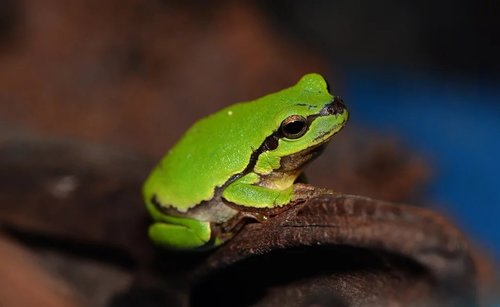
Amphibia · Anura
Hyla annectansJerdon, 1870
Assam Treefrog
Photograph by Zinogre, CC BY-SA, via iNaturalist
A nocturnal frog reaching 43 mm snout to vent.
Also called Green Leave Frog, Indian Hylid Frog, Indian Leaf Frog.
Amphibia › Anura › Hylidae › Hyla
- Grows to
- 42.8mm
- greatest recorded
- Active
- Nocturnal
- Lives up to
- 5years
- Lives
- Arboreal, terrestrial
Longer than 50% of all species in Hylidae anyone has measured.
The bar is the rank itself: its length is the share of the family this animal exceeds. The chart below is the family’s real spread, on a logarithmic scale because body length here runs from 16.5 to 165 mm. The solid rule is this animal. Every bar is a count of real species, and nothing on this figure is estimated.
What is known
21 sourced facts, each taken from a named scientific dataset. How to read these.
Cited from a dataset unless a row is marked otherwise.
Standing in the world
- Conservation status
- Least Concern
- Population trend
- Decreasing
as reported by the IUCN Red List
The animal itself
- Longest recorded life
- 5years
Size
- Length snout to vent · greatest recorded
- 42.8mm1.75 in
- Length snout to vent · adult female mean
- 37mm1.5 in
- Length snout to vent · adult male mean
- 35.3mm1.5 in
- Body mass · greatestmeasured
- 6.5g0.23 oz
snout-to-vent length, as this source reports for Anura
mean adult female snout-to-vent length
mean adult male snout-to-vent length
maximum adult body mass as recorded in the source
How it lives
- Eats arthropods
- Unknown
- Eats vertebrates
- Unknown
- Eats plant matter
- Unknown
- Active
- Nocturnal
- Where it lives
- Arboreal, terrestrial
- Active in
- Wet and warm
a blank flag in this source means unrecorded, not absent
Breeding
- Reproduction
- Oviparous
- How the young develop
- Through a larval stage
- Clutches in a year
- 1per year
- Mature at
- 1–2years
- Size at maturity
- 29–38mm1.25–1.5 in
Naming and history
- Described by
- Jerdon
- Moved to another genus · since it was first described
- Yes
- Described in
- 1870
Keeping one
- Land
- 43 × 21cm
- Water, at least 9 cm deep
- 9 × 4cm
Minimum, and for two animals — which is how the standard states it. Bigger is always better. Around 43 cm tall on average.
The standard gives 10 × 5 body lengths of land and 2 × 1 of water, for two animals.
For each further animal the standard asks for another 9 × 9 cm of land and 4 × 4 cm of water.
Swiss Tierschutzverordnung (TSchV), SR 455.1, Anhang 2, Tabelle 6 — legally binding minimum enclosure sizes for amphibians, given as multiples of total body length and stated for two animals.
From this animal’s own snout-vent length, which for a frog is its body length of 1.75 in (42.8 mm) — how this is worked out.
Assam Treefrog
Feeding
1kJ per day
Worked out for an animal of 7 g, the heaviest recorded for Assam Treefrog — so it is the top of the range, not a figure for a particular animal. Weigh yours and the number will be lower.
An upper estimate, not a feeding target, and not veterinary advice. The equation covers only what an animal burns staying alive, so a growing, gravid or recovering animal needs more — and it was measured on wild animals, which move far more than one in an enclosure. Body condition and a vet who knows the species are what a feeding decision should rest on. Where this comes from.
What nobody knows
These are not gaps in our research. No scientific dataset records them for this species — and saying so is information you cannot get from a reference that simply leaves a field out.
- — Still living
- — Length snout to vent · adult mean
- — Length nose to tail · greatest recorded
- — Female length · mean, nose to tail
- — Length nose to tail · adult male mean
- — Length nose to tail · adult mean
- — Largest female · snout to vent
- — Largest male · snout to vent
- — Largest female · shell length
- — Largest male · shell length
- — Hatchling length · snout to vent
- — Hatchling length · nose to tail
- — Largest juvenile · snout to vent
- — Largest juvenile · shell length
- — Egg length
- — Egg width
- — Body mass · a typical adult
- — Body mass · adult female, mean
- — Body mass at hatching
- — Preferred body temperature · chosen in a laboratory gradient
- — Body temperature when active · measured in the wild
- — Diet
- — How it hunts
- — Gestation or incubation
- — Average clutch
- — Smallest clutch recorded
- — Largest clutch recorded
- — Mean clutch · smallest reported
- — Mean clutch · largest reported
- — Clutches a year · fewest
- — Clutches a year · most
- — First breeds from · youngest recorded
- — First breeds by · oldest recorded
- — Hatchling length · smallest recorded
- — Hatchling length · largest recorded
- — Age at first breeding · female
- — Venomous
- — Fangs
- — Body temp in the wild · lowest mean recorded
- — Body temp in the wild · highest mean recorded
- — Limbs
- — Colour on the back
- — Pattern on the back
- — Pupil
- — Sex decided by
- — Status assessed · the year the Red List last looked
- — Red List criteria
- — Region
- — Biome
- — Active season · shortest recorded
- — Active season · longest recorded
- — Density · lowest recorded
- — Density · highest recorded
- — Home range · largest recorded
- — Suborder
- — Infraorder
- — Subspecies
- — Type locality
- — Habitat
- — Mainland or island
- — Lowest it lives · above sea level
- — Highest it lives · above sea level
- — Range size
Others in Hylidae
Take this data
Everything on this page is available as data under CC BY 4.0 — use it freely, credit it, no permission needed.
This species as JSON · the whole dataset
Cite this page
The Reptile & Amphibian Encyclopedia (2026). Hyla annectans. Retrieved 2026-10-13, from https://www.allanglescreatures.com/species/hyla-annectans
@misc{hyla_annectans_2026,
  title  = {Hyla annectans},
  author = {{The Reptile & Amphibian Encyclopedia}},
  year   = {2026},
  url    = {https://www.allanglescreatures.com/species/hyla-annectans}
}
Sources
- Oliveira, B.F. et al. (2017). AmphiBIO, a global database for amphibian ecological traits. Scientific Data 4:170123. Used under CC BY 4.0.
- GBIF Secretariat. GBIF Backbone Taxonomy. Used under CC BY 4.0. Common names aggregated from constituent checklists.
- Catalogue of Life (dataset 3LR), used under CC BY.
- Huang, N. et al. (2023). Amphibian traits database: a global database on morphological traits of amphibians. Global Ecology and Biogeography 32, 633-641. Used under CC BY 4.0.
- Moura, M. R. et al. TetrapodTraits: a database of 33,281 tetrapod species. Used under CC BY 4.0. Observed values only; this encyclopedia does not publish its imputed predictions.