
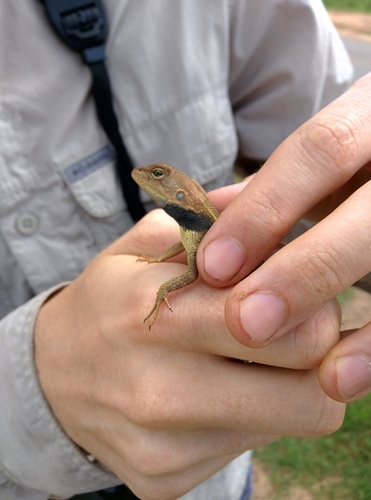
Reptilia · Squamata
Diporiphora jugularisMacleay, 1877
Black-throated two-pored dragon
Photograph by Nathan Ruser, CC BY, via iNaturalist
A day-active lizard from the Australo-Pacific region, reaching 68 mm snout to vent.
Reptilia › Squamata › Agamidae › Diporiphora
We do not have enough on this species yet
Catalogue of Life records this animal’s name, its family and where it sits in the tree of life. Beyond that, only 18 facts are on record — no diet, no lifespan, nothing we would be willing to publish as an entry.
So this page waits here rather than pretending to be one. It is not listed and not submitted to search engines. If you know this animal and can point us at a published source, we would rather have it right than have it soon.
- Grows to
- 68mm
- greatest recorded
- Active
- Diurnal
- Weighs up to
- 10.09g
- greatest
Longer than only 23% of all agamids anyone has measured.
The bar is the rank itself: its length is the share of the family this animal exceeds. The chart below is the family’s real spread, on a logarithmic scale because body length here runs from 32 to 418 mm. The solid rule is this animal. Every bar is a count of real species, and nothing on this figure is estimated.
What is known
18 sourced facts, each taken from a named scientific dataset. How to read these.
Cited from a dataset unless a row is marked otherwise.
Standing in the world
- Still living
- Extant
The animal itself
- Limbs
- Four legs
- Venomous
- No
- Fangs
- None
Size
- Length snout to vent · greatest recorded
- 68mm2.75 in
- Body mass · greatestcomputed
- 10.09g0.36 oz
Shai Meiri, unpublished
computed from length by a family-level allometric equation, not weighed
How it lives
- Active
- Diurnal
- Biome
- Tropical & Subtropical Grasslands, Savannas & Shrublands
- Region
- Australo-Pacific
- Mainland or island
- Mainland
- Range size
- 60,261km²
(presumed close to its sister, Diporiphora australis Melville et al. 2019), photo in Melville and Wilson 2019
Naming and history
- Suborder
- Sauria
- Infraorder
- Acrodontia
- Subspecies
- No
- Described by
- Macleay
- Moved to another genus · since it was first described
- Yes
- Described in
- 1877
- Type locality
- Australia
What nobody knows
These are not gaps in our research. No scientific dataset records them for this species — and saying so is information you cannot get from a reference that simply leaves a field out.
- — Length snout to vent · adult female mean
- — Length snout to vent · adult male mean
- — Length snout to vent · adult mean
- — Length nose to tail · greatest recorded
- — Female length · mean, nose to tail
- — Length nose to tail · adult male mean
- — Length nose to tail · adult mean
- — Largest female · snout to vent
- — Largest male · snout to vent
- — Largest female · shell length
- — Largest male · shell length
- — Hatchling length · snout to vent
- — Hatchling length · nose to tail
- — Largest juvenile · snout to vent
- — Largest juvenile · shell length
- — Egg length
- — Egg width
- — Body mass · a typical adult
- — Body mass · adult female, mean
- — Body mass at hatching
- — Longest recorded life
- — Preferred body temperature · chosen in a laboratory gradient
- — Body temperature when active · measured in the wild
- — Diet
- — Eats arthropods
- — Eats vertebrates
- — Eats plant matter
- — How it hunts
- — Where it lives
- — Reproduction
- — How the young develop
- — Gestation or incubation
- — Average clutch
- — Smallest clutch recorded
- — Largest clutch recorded
- — Mean clutch · smallest reported
- — Mean clutch · largest reported
- — Clutches in a year
- — Clutches a year · fewest
- — Clutches a year · most
- — First breeds from · youngest recorded
- — First breeds by · oldest recorded
- — Hatchling length · smallest recorded
- — Hatchling length · largest recorded
- — Age at first breeding · female
- — Mature from · youngest recorded
- — Mature by · oldest recorded
- — Size at maturity · smallest recorded
- — Size at maturity · largest recorded
- — Body temp in the wild · lowest mean recorded
- — Body temp in the wild · highest mean recorded
- — Colour on the back
- — Pattern on the back
- — Pupil
- — Sex decided by
- — Conservation status
- — Status assessed · the year the Red List last looked
- — Population trend
- — Red List criteria
- — Active season · shortest recorded
- — Active season · longest recorded
- — Density · lowest recorded
- — Density · highest recorded
- — Home range · largest recorded
- — Habitat
- — Active in
- — Lowest it lives · above sea level
- — Highest it lives · above sea level
Others in Agamidae
Sources
- Meiri, S. (2024). SquamBase — a database of squamate (Reptilia: Squamata) traits. Global Ecology and Biogeography. Public domain (CC0).
- Catalogue of Life (dataset 3LR), used under CC BY.
- Oskyrko, O. et al. (2024). ReptTraits: a comprehensive dataset of ecological traits in reptiles. Scientific Data. Used under CC BY 4.0.