
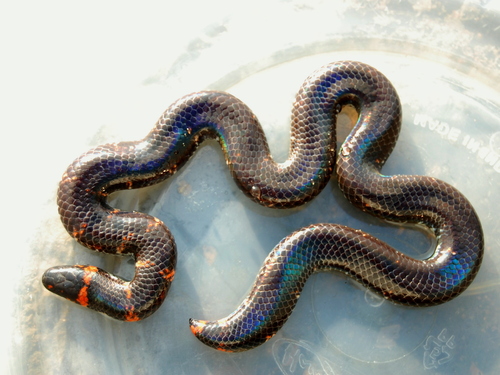
Reptilia · Squamata
Cylindrophis ruffusLaurenti, 1768
Red Cylinder Snake
Photograph by Abu Hamas, CC BY-SA, via iNaturalist
A nocturnal, meat-eating lizard from the Oriental region, reaching 100 cm nose to tail.
Also called Mirza’s Pipe-Snake, Red-tailed Pipe Snake.
Reptilia › Squamata › Cylindrophiidae › Cylindrophis
- Grows to
- 1000mm
- greatest recorded
- Eats
- Carnivorous
- Active
- Nocturnal
- Lives
- Fossorial, terrestrial
What is known
30 sourced facts, each taken from a named scientific dataset. How to read these.
Cited from a dataset unless a row is marked otherwise.
Standing in the world
- Still living
- Extant
- Conservation status
- Least Concern
- Status assessed · the year the Red List last looked
- 2011
- Population trend
- Increasing
The animal itself
- Limbs
- None
- Colour on the back
- Brown
- Venomous
- No
- Fangs
- None
Size
- Length nose to tail · greatest recorded
- 1000mm3 ft 3 in
- Body mass · greatestcomputed
- 227.8g8 oz
snakes only in this source
computed from length by a family-level allometric equation, not weighed
How it lives
- Diet
- Carnivorous
- How it hunts
- Active foraging
- Active
- Nocturnal
- Where it lives
- Fossorial, terrestrial
- Habitat
- Grassland, Savanna, Wetlands
- Biome
- Tropical & Subtropical Moist Broadleaf Forests
- Region
- Oriental
- Mainland or island
- Mainland
- Highest it lives · above sea level
- 1680m
- Range size
- 138,866km²
snakes, conger eels (Wang et al. 2023), snakes, eels, caecilian (Kupfer et al. 2003, Cox et al. 2012)
Wang et al. 2023
Feldman 2015, Cox et al. 2012
Fossorial&Terrestrial (Feldman 2015), see also Kupfer et al. 2003, fossorial and aquatic (!, Cox et al. 2012)
0-1675 (O'Shea 2018)
Breeding
- Reproduction
- Viviparous
- Average clutch
- 8eggs
- Eggs or young per clutch
- 5–13eggs
Feldman et al. 2015
5-13 (O'Shea 2018, Cox et al. 2012)
Naming and history
- Suborder
- Serpentes
- Infraorder
- Alethinophidia
- Subspecies
- No
- Described by
- Laurenti
- Moved to another genus · since it was first described
- Yes
- Described in
- 1768
- Type locality
- Indonesia
Feeding
A prey item should be no wider than the space between the animal's eyes.
Widely used across reptile husbandry references. The stated reason is that the gap approximates the width of the throat, so wider prey is associated with impaction. This is established practice, not a measurement.
24kJ per day
Worked out for an animal of 228 g, the heaviest recorded for Red Cylinder Snake — so it is the top of the range, not a figure for a particular animal. Weigh yours and the number will be lower.
An upper estimate, not a feeding target, and not veterinary advice. The equation covers only what an animal burns staying alive, so a growing, gravid or recovering animal needs more — and it was measured on wild animals, which move far more than one in an enclosure. Body condition and a vet who knows the species are what a feeding decision should rest on. Where this comes from.
What nobody knows
These are not gaps in our research. No scientific dataset records them for this species — and saying so is information you cannot get from a reference that simply leaves a field out.
- — Length snout to vent · greatest recorded
- — Length snout to vent · adult female mean
- — Length snout to vent · adult male mean
- — Length snout to vent · adult mean
- — Female length · mean, nose to tail
- — Length nose to tail · adult male mean
- — Length nose to tail · adult mean
- — Largest female · snout to vent
- — Largest male · snout to vent
- — Largest female · shell length
- — Largest male · shell length
- — Hatchling length · snout to vent
- — Hatchling length · nose to tail
- — Largest juvenile · snout to vent
- — Largest juvenile · shell length
- — Egg length
- — Egg width
- — Body mass · a typical adult
- — Body mass · adult female, mean
- — Body mass at hatching
- — Longest recorded life
- — Preferred body temperature · chosen in a laboratory gradient
- — Body temperature when active · measured in the wild
- — Eats arthropods
- — Eats vertebrates
- — Eats plant matter
- — How the young develop
- — Gestation or incubation
- — Mean clutch · smallest reported
- — Mean clutch · largest reported
- — Clutches in a year
- — Clutches a year · fewest
- — Clutches a year · most
- — First breeds from · youngest recorded
- — First breeds by · oldest recorded
- — Hatchling length · smallest recorded
- — Hatchling length · largest recorded
- — Age at first breeding · female
- — Mature from · youngest recorded
- — Mature by · oldest recorded
- — Size at maturity · smallest recorded
- — Size at maturity · largest recorded
- — Body temp in the wild · lowest mean recorded
- — Body temp in the wild · highest mean recorded
- — Pattern on the back
- — Pupil
- — Sex decided by
- — Red List criteria
- — Active season · shortest recorded
- — Active season · longest recorded
- — Density · lowest recorded
- — Density · highest recorded
- — Home range · largest recorded
- — Active in
- — Lowest it lives · above sea level
Others in Cylindrophiidae
Take this data
Everything on this page is available as data under CC BY 4.0 — use it freely, credit it, no permission needed.
This species as JSON · the whole dataset
Cite this page
The Reptile & Amphibian Encyclopedia (2026). Cylindrophis ruffus. Retrieved 2026-10-13, from https://www.allanglescreatures.com/species/cylindrophis-ruffus
@misc{cylindrophis_ruffus_2026,
  title  = {Cylindrophis ruffus},
  author = {{The Reptile & Amphibian Encyclopedia}},
  year   = {2026},
  url    = {https://www.allanglescreatures.com/species/cylindrophis-ruffus}
}
Sources
- Meiri, S. (2024). SquamBase — a database of squamate (Reptilia: Squamata) traits. Global Ecology and Biogeography. Public domain (CC0).
- Oskyrko, O. et al. (2024). ReptTraits: a comprehensive dataset of ecological traits in reptiles. Scientific Data. Used under CC BY 4.0.
- Catalogue of Life (dataset 3LR), used under CC BY.