
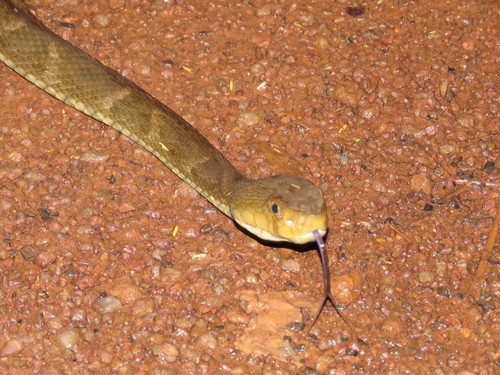
Reptilia · Squamata
Bothrops atroxLinnaeus, 1758
Fer-de-Lance
Photograph by Vincent A. Vos, CC BY, via iNaturalist
An active by day or night, meat-eating snake from the Neotropic region, reaching 172 cm nose to tail.
Also called Barba Amarilla, common lancehead.
Reptilia › Squamata › Viperidae › Bothrops
- Grows to
- 1718mm
- greatest recorded
- Eats
- Carnivorous
- Active
- Cathemeral
- Lives up to
- 8.5years
Longer than 92% of all vipers anyone has measured.
The bar is the rank itself: its length is the share of the family this animal exceeds. The chart below is the family’s real spread, on a logarithmic scale because body length here runs from 280 to 3,900 mm. The solid rule is this animal. Every bar is a count of real species, and nothing on this figure is estimated.
What is known
34 sourced facts, each taken from a named scientific dataset. How to read these.
Cited from a dataset unless a row is marked otherwise.
Standing in the world
- Still living
- Extant
- Conservation status
- Least Concern
- Status assessed · the year the Red List last looked
- 2015
- Population trend
- Stable
The animal itself
- Limbs
- None
- Venomous
- Yes
- Fangs
- At the front of the mouth
- Longest recorded life
- 8.5years
Stark et al. 2020
Size
- Length snout to vent · greatest recorded
- 1525mm5 ft
- Length nose to tail · greatest recorded
- 1718mm5 ft 8 in
- Body mass · greatestcomputed
- 1934.6g4.3 lb
- Body mass · a typical adult
- 1037g2.3 lb
- Body mass at hatchingmeasured
- 14.5g0.51 oz
1532 mm total length (Feldman et al. 2016), Starace et al. 2023 (1 female 1570 mm in total length (TL) and 1360 mm in snout–vent length; literature: "The largest reported sizes for Common Lancehead females come from Brazilian Amazonia: 1230 mm SVL (Tavares-Pinheiro et al., 2020), 1415 mm TL (1265 mm SVL; Bisneto and Kaefer, 2019), 1460 mm TL (Cunha and Nascimento, 1978), and 1532 mm TL (Martins and Oliveira, 1998). An individual of 1718 mm TL (1525 mm SVL) was encountered in Colombia (Quiñones-Betancourt et al., 2018). A total length of 2000 mm is assumed to be the maximum length for the species (Campbell and Lamar, 1989). In French Guiana, the largest female previously reported measured 1220 mm TL (Gasc and Rodrigues, 1980)")
snakes only in this source
computed from length by a family-level allometric equation, not weighed
AnAge rates this record "acceptable"
How it lives
- Diet
- Carnivorous
- How it hunts
- Sit and wait
- Active
- Cathemeral
- Where it lives
- Arboreal, terrestrial
- Habitat
- Forest, Wetlands
- Biome
- Tropical & Subtropical Moist Broadleaf Forests
- Region
- Neotropic
- Mainland or island
- Mainland
- Elevation · above sea level
- 10–1590m
- Range size
- 6,707,900km²
lizards and rodents (da Frota et al. 2021), carnivore (see Pinto‐Coelho et al. 2021), arthropods, amphibians, lizards, mammals and snakes (Starace et al. 2021, 2023)
Sit (Glaudas et al. 2019)
4 diurnal, 12 nocturnal (da Frota et al. 2021)
semiarboreal (Pinto‐Coelho et al. 2021), 14 terrrestrial, 2 arboreal (da Frota et al. 2021)
50-1584 (Señaris and Rojas-Runjaic 2019, Señaris & Rojas-Runjaic 2020), 15 (Starace et al. 2023)
Breeding
- Reproduction
- Viviparous
- Average clutch
- 31eggs
- Eggs or young per clutch
- 5–86eggs
- Mean clutch
- 11–31eggs
Feldman et al. 2015
5-86 n: unknown (Henderson 2010; ver high maximum?), 8-33 mean=31 (O'Shea 2011, Schuett et al. 2002), Starace et al. 2023 (42 in their specimen; in the literature 3-43; one average of 11)
Naming and history
- Suborder
- Serpentes
- Infraorder
- Alethinophidia
- Subspecies
- No
- Described by
- Linnaeus
- Moved to another genus · since it was first described
- Yes
- Described in
- 1758
- Type locality
- Asia” (in error); true locality unknown
Keeping one
5 ft 8 in × 2 ft 10 in × 8 ft 5 in(172 × 86 × 258 cm)
Minimum length × width × height, for one animal. Bigger is always better.
The standard sizes snakes as a fraction of total length: 1 × 0.5 × 1.5.
Recorded both on the ground and climbing, so this is the larger of the two rules in every dimension.
Mindestanforderungen an die Haltung von Reptilien (Sachverständigengutachten), German Federal Ministry for Nutrition, Agriculture and Forestry, Animal Welfare Division, 10 January 1997. The standard states these floor areas are recommendations rather than binding limits.
From this animal’s own total length of 5 ft 8 in (1718 mm), at 1 × 0.5 × 1.5 times it, following the German federal welfare standard — how this is worked out.
No preferred body temperature has been recorded for Fer-de-Lance. Rather than repeat a number from a care sheet, this page leaves it out.
Feeding
A prey item should be between the same width as the widest part of the snake's body and about 1.5 times that width.
Widely used across snake husbandry references. An alternative formulation gives prey at 10-15% of the snake's body mass. This is established practice, not a measurement.
164kJ per day
Worked out for an animal of 1,935 g, the heaviest recorded for Fer-de-Lance — so it is the top of the range, not a figure for a particular animal. Weigh yours and the number will be lower.
An upper estimate, not a feeding target, and not veterinary advice. The equation covers only what an animal burns staying alive, so a growing, gravid or recovering animal needs more — and it was measured on wild animals, which move far more than one in an enclosure. Body condition and a vet who knows the species are what a feeding decision should rest on. Where this comes from.
What nobody knows
These are not gaps in our research. No scientific dataset records them for this species — and saying so is information you cannot get from a reference that simply leaves a field out.
- — Length snout to vent · adult female mean
- — Length snout to vent · adult male mean
- — Length snout to vent · adult mean
- — Female length · mean, nose to tail
- — Length nose to tail · adult male mean
- — Length nose to tail · adult mean
- — Largest female · snout to vent
- — Largest male · snout to vent
- — Largest female · shell length
- — Largest male · shell length
- — Hatchling length · snout to vent
- — Hatchling length · nose to tail
- — Largest juvenile · snout to vent
- — Largest juvenile · shell length
- — Egg length
- — Egg width
- — Body mass · adult female, mean
- — Preferred body temperature · chosen in a laboratory gradient
- — Body temperature when active · measured in the wild
- — Eats arthropods
- — Eats vertebrates
- — Eats plant matter
- — How the young develop
- — Gestation or incubation
- — Clutches in a year
- — Clutches a year · fewest
- — Clutches a year · most
- — First breeds from · youngest recorded
- — First breeds by · oldest recorded
- — Hatchling length · smallest recorded
- — Hatchling length · largest recorded
- — Age at first breeding · female
- — Mature from · youngest recorded
- — Mature by · oldest recorded
- — Size at maturity · smallest recorded
- — Size at maturity · largest recorded
- — Body temp in the wild · lowest mean recorded
- — Body temp in the wild · highest mean recorded
- — Colour on the back
- — Pattern on the back
- — Pupil
- — Sex decided by
- — Red List criteria
- — Active season · shortest recorded
- — Active season · longest recorded
- — Density · lowest recorded
- — Density · highest recorded
- — Home range · largest recorded
- — Active in
Others in Viperidae
Take this data
Everything on this page is available as data under CC BY 4.0 — use it freely, credit it, no permission needed.
This species as JSON · the whole dataset
Cite this page
The Reptile & Amphibian Encyclopedia (2026). Bothrops atrox. Retrieved 2026-10-13, from https://www.allanglescreatures.com/species/bothrops-atrox
@misc{bothrops_atrox_2026,
  title  = {Bothrops atrox},
  author = {{The Reptile & Amphibian Encyclopedia}},
  year   = {2026},
  url    = {https://www.allanglescreatures.com/species/bothrops-atrox}
}
Sources
- Meiri, S. (2024). SquamBase — a database of squamate (Reptilia: Squamata) traits. Global Ecology and Biogeography. Public domain (CC0).
- Oskyrko, O. et al. (2024). ReptTraits: a comprehensive dataset of ecological traits in reptiles. Scientific Data. Used under CC BY 4.0.
- Catalogue of Life (dataset 3LR), used under CC BY.
- AnAge, Human Ageing Genomic Resources (de Magalhães et al.), used under CC BY 3.0.