
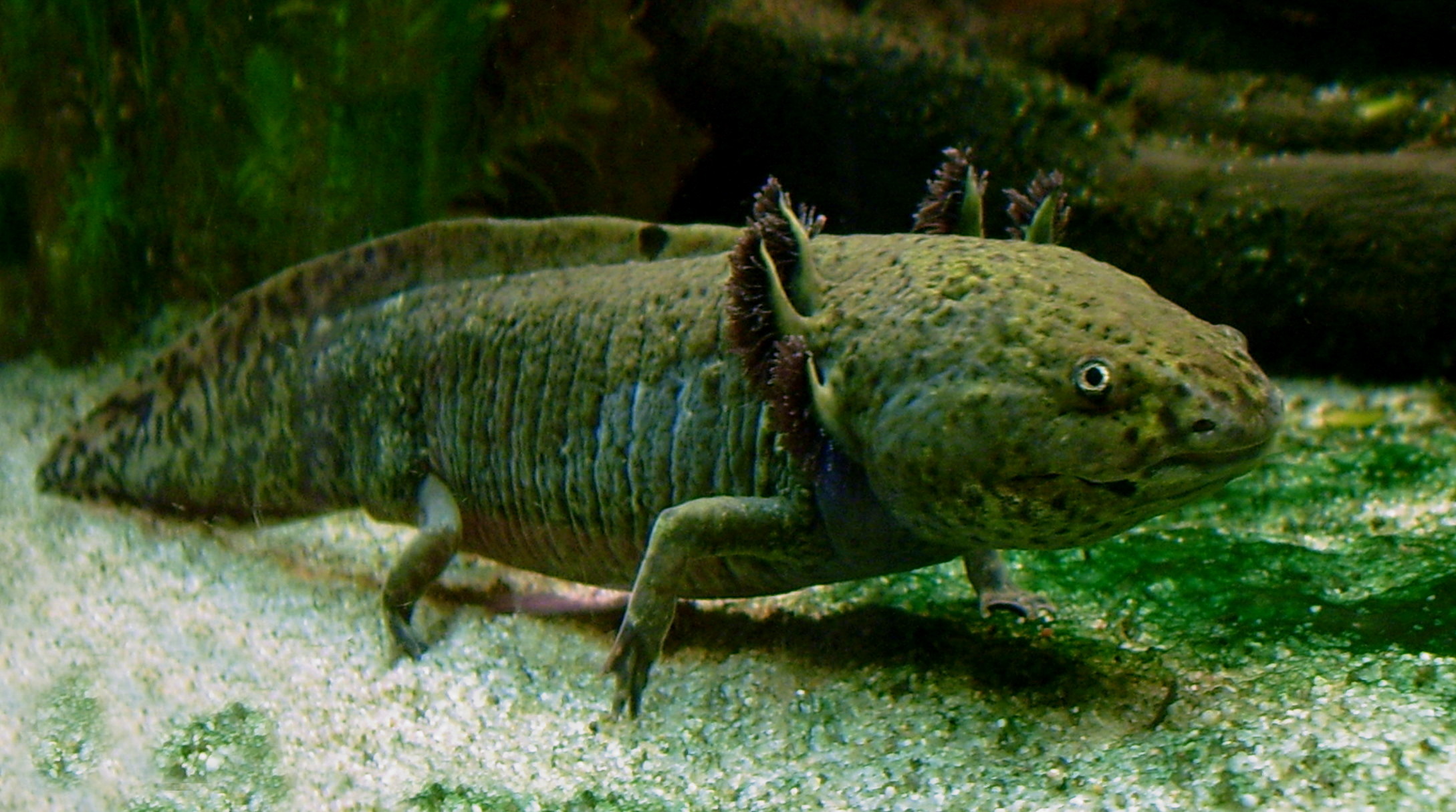
Amphibia · Caudata
Ambystoma mexicanumShaw & Nodder, 1798
Axolotl
Photograph by LoKiLeCh, CC BY-SA, via Wikimedia Commons

A day-active salamander reaching 300 mm nose to tail.
Amphibia › Caudata › Ambystomatidae › Ambystoma
- Grows to
- 300mm
- greatest recorded
- Active
- Diurnal
- Lives up to
- 17years
- Lives
- Aquatic, fossorial
Longer than 83% of all species in Ambystomatidae anyone has measured.
The bar is the rank itself: its length is the share of the family this animal exceeds. The chart below is the family’s real spread, on a logarithmic scale because body length here runs from 88 to 340 mm. The solid rule is this animal. Every bar is a count of real species, and nothing on this figure is estimated.
What is known
20 sourced facts, each taken from a named scientific dataset. How to read these.
Cited from a dataset unless a row is marked otherwise.
Standing in the world
- Conservation status
- Critically Endangered
- Population trend
- Decreasing
as reported by the IUCN Red List
The animal itself
- Longest recorded life
- 17years
Size
- Length snout to vent · adult female mean
- 125mm5 in
- Length snout to vent · adult male mean
- 132mm5.25 in
- Length nose to tail · greatest recorded
- 300mm12 in
mean adult female snout-to-vent length
mean adult male snout-to-vent length
total length, tail included — this source reports total length for Caudata and Gymnophiona
How it lives
- Eats arthropods
- Unknown
- Eats vertebrates
- Unknown
- Eats plant matter
- Unknown
- Active
- Diurnal
- Where it lives
- Aquatic, fossorial
a blank flag in this source means unrecorded, not absent
Breeding
- Reproduction
- Oviparous
- How the young develop
- Through a larval stage
- Gestation or incubation
- 18days
- Clutches in a year
- 1per year
- Age at first breeding · female
- 548days
- Mature at
- 1.5years
AnAge rates this record "acceptable"
Naming and history
- Described by
- Shaw & Nodder
- Moved to another genus · since it was first described
- Yes
- Described in
- 1798
Keeping one
Axolotl is assessed as Critically Endangered on the IUCN Red List. Species at risk in the wild are often covered by CITES and by national law, which decide what may be bought, sold, moved across a border or kept at all — and captive-bred and wild-caught animals are usually treated differently. Check the rules where you are before acquiring one. Nothing below is a judgement about keeping this species; it is what a published welfare standard says about space, and what the animal itself was measured doing.
- Water, at least 60 cm deep
- 120 × 60cm
Minimum, and for two animals — which is how the standard states it. Bigger is always better.
This animal lives in water, so the standard gives 4 × 2 body lengths of water and no land area, for two animals.
For each further animal, another 30 × 30 cm of water.
Swiss Tierschutzverordnung (TSchV), SR 455.1, Anhang 2, Tabelle 6 — legally binding minimum enclosure sizes for amphibians, given as multiples of total body length and stated for two animals.
From this animal’s own total length of 12 in (300 mm) — how this is worked out.
Axolotl
Morphs
7 with peer-reviewed genetics behind them, 3 resting on breeder consensus. Most references present both with the same confidence.
What each pairing produces → · Two genes at once →
No melanin anywhere, giving clear or pink eyes. Golden albinos keep their yellow pigment; white albinos are albino and leucistic together.
- Experimental studies on a mutant gene, a, causing albinism in the axolotl, Ambystoma mexicanum. — Dev Biol 1978
- Albino axolotls from an albino tiger salamander through hybridization. — J Hered 1967
- Identification of mutant genes and introgressed Tiger salamander DNA in the laboratory axolotl, Ambystoma mexicanum. — Sci Rep 2017
- Axanthicpeer reviewed
Grey to near-black, with the yellow and red pigment cells absent.
- Coat colourpeer reviewed
- Genetic analysis of steel and the PG-M/versican-encoding gene AxPG as candidates for the white (d) pigmentation mutant in the salamander Ambystoma mexicanum — Development Genes & Evolution 1999
- Genetic and developmental characteristics of a new color variant, axanthic, in the Mexican axolotl, Ambystoma mexicanum Shaw. — Dev Biol 1971
Light coppery brown with grey-brown speckling, produced by a variant that makes only a reduced form of melanin.
- Tyrp1 is the mendelian determinant of the Axolotl (Ambystoma mexicanum) copper mutant. — Sci Rep 2024
- GFPpeer reviewed
Carries a jellyfish gene inserted in a laboratory, which makes the tissue glow green under blue or ultraviolet light. Invisible in ordinary light.
Worth knowing. This is a transgene from laboratory research stock, not a mutation that arose in axolotls. One copy is enough to see it, so a GFP animal bred to a normal one produces about half GFP offspring.
Pale pink or white skin with dark eyes, and usually some pigment on the head and gills. Not an albino: the eyes carry pigment.
- Identification of mutant genes and introgressed Tiger salamander DNA in the laboratory axolotl, Ambystoma mexicanum. — Sci Rep 2017
- Melanoidpeer reviewed
Kabangu et al. (2023): "The melanoid axolotl is a Mendelian variant characterized by large numbers of melanophores, proportionally fewer xanthophores, and no iridophores."
- Patterns of purine synthesis related to iridophore development in the wild type, melanoid, and axanthic strains of the Mexican axolotl, Ambystoma mexicanum Shaw. — Dev Biol 1974
- What insights into vertebrate pigmentation has the axolotl model system provided? — Int J Dev Biol 1996
- A color variant in the Mexican axolotl. — Journal of Heredity 1967
- Chimerabreeder consensus
An animal split down the midline into two colours, because two separate embryos fused into one before hatching.
Worth knowing. A chimera is two embryos that fused, so it is not carried by any gene. It cannot be bred for, no pairing makes it more likely, and a chimera's own offspring are ordinary animals. Chimeras are regularly sold at a premium to keepers who intend to breed them.
- Mosaicbreeder consensus
Colours scattered in patches rather than split down the middle, from a cell-division event after fertilisation.
Worth knowing. Like a chimera, a mosaic arises during development rather than from a gene. It cannot be bred for and does not pass to its offspring.
- Wild typebreeder consensus
The natural colouring: dark brown to greenish with darker speckling and gold flecks. Its depth varies with the parents chosen and with the tank.
Other inherited traits
Inherited characteristics and conditions recorded for this species. These are not morphs — nobody breeds for them.
- Regenerative potential2 references
What nobody knows
These are not gaps in our research. No scientific dataset records them for this species — and saying so is information you cannot get from a reference that simply leaves a field out.
- — Still living
- — Length snout to vent · greatest recorded
- — Length snout to vent · adult mean
- — Female length · mean, nose to tail
- — Length nose to tail · adult male mean
- — Length nose to tail · adult mean
- — Largest female · snout to vent
- — Largest male · snout to vent
- — Largest female · shell length
- — Largest male · shell length
- — Hatchling length · snout to vent
- — Hatchling length · nose to tail
- — Largest juvenile · snout to vent
- — Largest juvenile · shell length
- — Egg length
- — Egg width
- — Body mass · greatest
- — Body mass · a typical adult
- — Body mass · adult female, mean
- — Body mass at hatching
- — Preferred body temperature · chosen in a laboratory gradient
- — Body temperature when active · measured in the wild
- — Diet
- — How it hunts
- — Average clutch
- — Smallest clutch recorded
- — Largest clutch recorded
- — Mean clutch · smallest reported
- — Mean clutch · largest reported
- — Clutches a year · fewest
- — Clutches a year · most
- — First breeds from · youngest recorded
- — First breeds by · oldest recorded
- — Hatchling length · smallest recorded
- — Hatchling length · largest recorded
- — Size at maturity · smallest recorded
- — Size at maturity · largest recorded
- — Venomous
- — Fangs
- — Body temp in the wild · lowest mean recorded
- — Body temp in the wild · highest mean recorded
- — Limbs
- — Colour on the back
- — Pattern on the back
- — Pupil
- — Sex decided by
- — Status assessed · the year the Red List last looked
- — Red List criteria
- — Region
- — Biome
- — Active season · shortest recorded
- — Active season · longest recorded
- — Density · lowest recorded
- — Density · highest recorded
- — Home range · largest recorded
- — Suborder
- — Infraorder
- — Subspecies
- — Type locality
- — Habitat
- — Active in
- — Mainland or island
- — Lowest it lives · above sea level
- — Highest it lives · above sea level
- — Range size
Others in Ambystomatidae
Take this data
Everything on this page is available as data under CC BY 4.0 — use it freely, credit it, no permission needed.
This species as JSON · the whole dataset
Cite this page
The Reptile & Amphibian Encyclopedia (2026). Ambystoma mexicanum. Retrieved 2026-10-13, from https://www.allanglescreatures.com/species/ambystoma-mexicanum
@misc{ambystoma_mexicanum_2026,
  title  = {Ambystoma mexicanum},
  author = {{The Reptile & Amphibian Encyclopedia}},
  year   = {2026},
  url    = {https://www.allanglescreatures.com/species/ambystoma-mexicanum}
}
Sources
- Moura, M. R. et al. TetrapodTraits: a database of 33,281 tetrapod species. Used under CC BY 4.0. Observed values only; this encyclopedia does not publish its imputed predictions.
- AnAge, Human Ageing Genomic Resources (de Magalhães et al.), used under CC BY 3.0.
- Oliveira, B.F. et al. (2017). AmphiBIO, a global database for amphibian ecological traits. Scientific Data 4:170123. Used under CC BY 4.0.
- GBIF Secretariat. GBIF Backbone Taxonomy. Used under CC BY 4.0. Common names aggregated from constituent checklists.
- Catalogue of Life (dataset 3LR), used under CC BY.
- Huang, N. et al. (2023). Amphibian traits database: a global database on morphological traits of amphibians. Global Ecology and Biogeography 32, 633-641. Used under CC BY 4.0.